Showing posts with label toy meerkat. Show all posts

Tuesday, January 25, 2011

Plastic Meerkats Set


This adorable group of meerkats is perfect as a toy or for a school project!

Check out the details of these wonderful meerkats (Suricata suricatta) by Safari Ltd. Superior design and details make these museum-quality replicas or collector's items, and yet the price puts them in range for the average collector.They can also be used as a toys. These meerkats are very sturdy and made of solid plastic. Note the realistically textured bodies. An information card is included with your purchase. This plastic meerkat is great for school projects, toys, novelties, party favors and more. You can make an interesting African shoebox diorama using this and other plastic creatures from our gift shop. Best of all, there is no mess, no feeding, and no tank or cage cleaning :) Be sure to look over our other meerkat toys and gifts.

The civet family (Viverridae) includes binturongs, civet cats, falanoucs, fossas, genet cats, linsangs, mongooses and meerkats (which are actually a type of mongoose). They are related to the cat family but are not actually cats. They do have a cat-like body, but with shorter legs and a longer tail. Their face resembles that of a weasel. These mostly nocturnal (active at night) mammals are native to Asia (including Indonesia and the Philippines), Africa (including Madagascar) and southern Europe. Some species are terrestrial (ground dwellers), but most are arboreal (tree dwellers); some are carnivores (eat only meat) and others are omnivores (eat fruits and vegetables as well as meat). Civet cats have scent-producing glands that secrete a musky-smelling substance which is used as a perfume fixative.

Meerkats are diurnal, which means they are active during the day. They have an average life span of 12-14 years. Meerkat populations move whenever their food supply becomes depleted. Being omnivores, meerkats eat both plants and animals. Meerkats can even eat scorpions because they are immune to their venom. However, the most significant characteristic of meerkats is their altruistic behavior. They are one of the few mammal species that significantly cooperates and coordinates activities with each other. Meerkat mothers are given an opportunity to go out to feed themselves while their young are watched by other meerkats. In fact, some meerkats spend all or part of their lives helping others raise their young rather than breeding themselves.

 
This blog is sponsored by Tapir and Friends Animal Store.

Sunday, December 20, 2009

Stuffed Meerkat

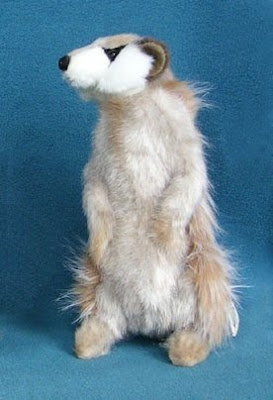
Who doesn't need a stuffed meerkat for Christmas? And we have just the one! It sits up, it looks almost real (in fact, our stuffed meerkat was used for some long-distance shots in "Meerkat Manor"! We will be shipping by Priority Mail on Monday, and you should get it before Christmas.

These plush meerkat stuffed animals are exceptional. They're as realistic as they are cute. Although they're made of synthetic materials, they look real. This one sits up surveying his territory.

The civet family (Viverridae) includes binturongs, civet cats, falanoucs, fossas, genet cats, linsangs, mongooses and meerkats (which are actually a type of mongoose). They are related to the cat family but are not actually cats. They do have a cat-like body, but with shorter legs and a longer tail. Their face resembles that of a weasel. These mostly nocturnal (active at night) mammals are native to Asia (including Indonesia and the Philippines), Africa (including Madagascar) and southern Europe. Some species are terrestrial (ground dwellers), but most are arboreal (tree dwellers); some are carnivores (eat only meat) and others are omnivores (eat fruits and vegetables as well as meat). Civet cats have scent-producing glands that secrete a musky-smelling substance which is used as a perfume fixative.

Meerkats are diurnal, which means they are active during the day. They have an average life span of 12-14 years. Meerkat populations move whenever their food supply becomes depleted. Being omnivores, meerkats eat both plants and animals. Meerkats can even eat scorpions because they are immune to their venom. However, the most significant characteristic of meerkats is their altruistic behavior. They are one of the few mammal species that significantly cooperates and coordinates acivities with each other. Meerkat mothers are given an opportunity to go out to feed themselves while their young are watched by other meerkats. In fact, some meerkats spend all or part of their lives helping others raise their young rather than breeding themselves.

Tuesday, December 8, 2009

Realistic stuffed meerkat by Hansa is back in stock and ready to ship!

Meerkat Stuffed Toy These plush meerkat stuffed animals are exceptional. They're as realistic as they are cute. Although they're made of synthetic materials, they look real. This one sits up surveying his territory.

The civet family (Viverridae) includes binturongs, civet cats, falanoucs, fossas, genet cats, linsangs, mongooses and meerkats (which are actually a type of mongoose). They are related to the cat family but are not actually cats. They do have a cat-like body, but with shorter legs and a longer tail. Their face resembles that of a weasel. These mostly nocturnal (active at night) mammals are native to Asia (including Indonesia and the Philippines), Africa (including Madagascar) and southern Europe. Some species are terrestrial (ground dwellers), but most are arboreal (tree dwellers); some are carnivores (eat only meat) and others are omnivores (eat fruits and vegetables as well as meat). Civet cats have scent-producing glands that secrete a musky-smelling substance which is used as a perfume fixative.

Meerkats are diurnal, which means they are active during the day. They have an average life span of 12-14 years. Meerkat populations move whenever their food supply becomes depleted. Being omnivores, meerkats eat both plants and animals. Meerkats can even eat scorpions because they are immune to their venom. However, the most significant characteristic of meerkats is their altruistic behavior. They are one of the few mammal species that significantly cooperates and coordinates acivities with each other. Meerkat mothers are given an opportunity to go out to feed themselves while their young are watched by other meerkats. In fact, some meerkats spend all or part of their lives helping others raise their young rather than breeding themselves.
Tuesday, March 24, 2009

"M" is for Meerkat, Mole and Mongoose

Look at these animals that start with "M"! We have stuffed meerkats sitting up tall and looking very real! We also have plenty of plastic meerkats, which you'll find by following the same link above.

This is one of several plastic mongoose replicas in our collection. Yes, we have more than one! You can follow the mongoose link above to find them all.

Isn't this stuffed mole charming? We have it in stock and ready to ship! Check out our stuffed mole here.

You might also like

Related Posts with Thumbnails