Showing posts with label people. Show all posts

Friday, June 20, 2014

Miniature Figurines of People for Your Diorama

Australian Aboriginal Ranger Plastic Figurine

Whether your diorama ia about the Australian outback or the frozen north, we may have just the human figurines you need to go along with the animals for your biome diorama.

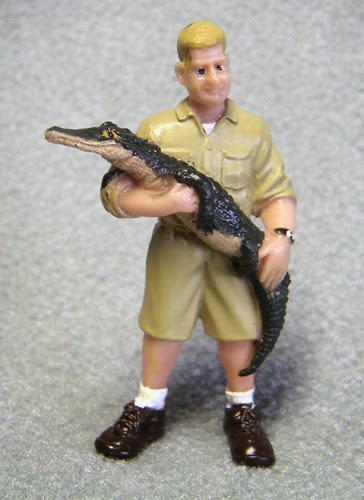
Alligator or Crocodile Handler Small Plastic Figurine (Man holding crocodile, looks like Steve Irwin)

Small Plastic Figurine of Eskimo Man with Spear


This blog is sponsored by Tapir and Friends Animal Store.

Tuesday, May 27, 2014

Happy Birthday, Rachel Carson!


“The more clearly we can focus our attention on the wonders
and realities of the universe about us,
the less taste we shall have for destruction."

 ~Rachel Carson, conservationist and author of Silent Spring~

May 27, 1907-April 14, 1964

This blog is sponsored by Tapir and Friends Animal Store.

Wednesday, February 6, 2013

King Tut of Egypt Plastic Funeral Mask


King Tut took power at age 10...the same age as my youngest child!!

Our Plastic King Tut Funeral Mask


This detailed plastic funeral mask of King Tut is well-made and realistic in both color and appearance. It is 1 5/8 inches tall. This funeral mask showing the Egyptian King Tutankhamen, the ruler of ancient Egypt in 1300 BC, fits well in a diorama for a school project about ancient Egypt or is a nice keepsake for a collector of religious symbols. Check out our other ancient Egyptian Kings and Queens and Ancient Egyptian toys and gifts.

About King Tut


Ruling Egypt as Pharoah from 1333 to 1323 BC, Tutankhamen was known as the "boy Pharoah". He took reign at the age of nine or ten, and lived only another ten years. It is widely belived that Tutankhamen died as a result of an infected broken leg. Tutankhamen gain modern fame and notoriety by being one of very few unplundered tombs of the ancient pharoahs of Egypt.

This blog is sponsored by Tapir and Friends Animal Store.

Tuesday, February 5, 2013

Anubis Plastic Replica


Come see our new collection of ancient Egyptian replicas!

Our NEW Anubis Statue Replica


This detailed plastic Egyptian God of the Dead toy is well-made and realistic in both color and appearance. It is 2 1/2 inches tall. This little icon showing the Egyptian God of the Dead, fits well in a diorama for a school project about ancient Egypt or is a nice keepsake for a collector of religious symbols. Check out our other ancient Egyptian Gods and Ancient Egyptian toys and gifts.

About Anubis


The ancient Egyptian panthenon provides many different Gods and Goddesses for different purposes. The God Anubis is the God of the Dead, and therefore was also the patron of mummification. With a jackal's head on a human body, Anubis drew the departed's soul into the afterlife and watched over them for eternity.

This blog is sponsored by Tapir and Friends Animal Store.

Saturday, January 12, 2013

Poseidon-as-Octopus Plastic Figure


Just don't make him angry!!

Our Plastic Poseidon Figure


Our plastic Poseidon figurine or educational toy is quite a character with his lower body turned into octopus tentacles and his gray hair flowing as if being tugged by the ocean currents. Poseidon stands 4 1/2 inches tall, and his tentacles reach to about 4 3/8 inches at the widest point. Poseiden/Neptune is made of solid, durable plastic and will hold up for hours of play and/or a long life on your shelf overseeing your other mythological and fantasy figurines. He swivels at the waist, apparently ready to spear any enemies that come his way with that forbidding-looking seaweed-covered trident! Please check out our extensive collection of sea creatures and fish along with our growing selection of mythical and legendary animals and anthropomorphic characters. Any of them would make a wonderful display along with our plastic Poseidon figurine.

About Poseidon and Neptune


Also known as Neptune and Nethuns, Poseidon is one of the twelve deities of the ancient Greek pantheon who ruled the world from Mt Olympus. Poseidon is primarily God of the Sea, but also was the source of earthquakes (hence the nickname Earth-shaker) and was known as the tamer of horses.

Like many ancient gods and goddesses, Poseidon’s exact lineage is unclear. However, there is a tale that links Poseidon as brother to Zeus (most powerful of the Greek gods) and Hades. The tale states that when the world was divided amongst the three most-powerful Gods of Olympus, Zeus was given the air, Hades the underworld, and Poseidon the oceans. This put Poseidon in position to be the most influential amongst the mortals. Indeed, Poseidon’s contest of wills with the ancient Greek king Odysseus formed the basis for Homer’s The Odyssey, one of the cornerstones of Western literature.

This blog is sponsored by Tapir and Friends Animal Store.

Friday, January 4, 2013

Plastic Aborigine Australian Ranger


He's working with us to protect wildlife and habitats!

Our Plastic Aborigine Australian Ranger


Our aboriginal ranger is made of solid plastic and measures 2 1/2 inches tall. He is wearing a pith helmet, sunglasses and bracelets.. This educational plastic aboriginal ranger is great for school projects, toys, novelties, animal collections, party favors and more. Our plastic ranger is for decoration or play only. You can make a marvelous Australian animals shoebox diorama using this and other plastic creatures from our gift shop.

About Aborigines


Aborigenes are the original inhabitants of Australia.and now make up only 2.6% of Australia's population. They migrated to Australia from Asia approx. 30,000 years ago. Though they comprise 500–600 distinct groups, aboriginal people possess some unifying links. Among these are strong spiritual beliefs that tie them to the land; a tribal culture of storytelling and art; and, like other indigenous populations, a difficult colonial history. Aborigines see a close relationship between themselves and land and their religion has a deep and mysterious relationship with dreaming. Also humans and the natural world are more unified. Ancestors live on as parts of the physical world.

This blog is sponsored by Tapir and Friends Animal Store.

Thursday, November 29, 2012

Plastic Neanderthal Woman


Looks like the Missus picked up a little something while she was out!

Our Plastic Neanderthal Woman


Our small plastic Neanderthal toy is just the right size replica for your prehistoric life shoebox diorama. This little cavewoman model will fit in a shoe box along with other examples of extinct life from the Earth's past. Add a caveman, few plastic animals, rocks, plants, grass, make a river or stream from anything that strikes your imagination, and there you go - a scene of life on our planet as it might have been thousands or millions of years ago. Our plastic toy caveman is made of solid plastic and is quite durable. Be sure to take a look at our other prehistoric figurines including neanderthals.

About Neanderthals


Neanderthals were an alternate (and now extinct) evolution of human beings who lived in what is now Europe and central Asia from 600,000 years to as modern as 24,500 years ago. Neanderthals are scientifically classified as both a subspecies of human (Homo sapiens neanderthalensis) and as an entirely separate human species (Homo neanderthalensis). This unique dual classification reflects a split amongst scientists regarding neanderthals relationship to modern humans.

Originally depicted by both popular culture and the scientific community as dark-skinned, hairy, over-muscled brutes, new evidence now suggests that neanderthals were more likely light-skinned with no more facial or body hair than modern humans. While neanderthals were significantly stronger than modern humans, examinations of neanderthal skulls show that the cranial capacity of neanderthals were as large as modern humans, allowing the theory that neanderthal brains were at least as large, and possibly larger, than modern human brains. Far from thoughtless brutes, it is now concluded that neanderthals existed in large social groups, had a language, and were capable of producing advanced tools and problem solving. Were you to see a neanderthal man in a modern setting, dressed in jeans and a tee shirt, you would probably think nothing more extravagant than "that dude really works out".

This blog is sponsored by Tapir and Friends Animal Store.

Monday, November 26, 2012

Plastic Neanderthal


Hi Honey. Could you pick up something on the way home for dinner?

Our Plastic Neanderthal Man


Our small plastic Neanderthal toy is just the right size replica for your prehistoric life shoebox diorama. This little caveman model will fit in a shoe box along with other examples of extinct life from the Earth's past. Add a cave woman, few plastic animals, rocks, plants, grass, make a river or stream from anything that strikes your imagination, and there you go - a scene of life on our planet as it might have been thousands or millions of years ago. Our plastic toy caveman is made of solid plastic and is quite durable. Be sure to take a look at our other prehistoric figurines including neanderthals.

About Neanderthals


Neanderthals were an alternate (and now extinct) evolution of human beings who lived in what is now Europe and central Asia from 600,000 years to as modern as 24,500 years ago. Neanderthals are scientifically classified as both a subspecies of human (Homo sapiens neanderthalensis) and as an entirely separate human species (Homo neanderthalensis). This unique dual classification reflects a split amongst scientists regarding neanderthals relationship to modern humans.

Originally depicted by both popular culture and the scientific community as dark-skinned, hairy, over-muscled brutes, new evidence now suggests that neanderthals were more likely light-skinned with no more facial or body hair than modern humans. While neanderthals were significantly stronger than modern humans, examinations of neanderthal skulls show that the cranial capacity of neanderthals were as large as modern humans, allowing the theory that neanderthal brains were at least as large, and possibly larger, than modern human brains. Far from thoughtless brutes, it is now concluded that neanderthals existed in large social groups, had a language, and were capable of producing advanced tools and problem solving. Were you to see a neanderthal man in a modern setting, dressed in jeans and a tee shirt, you would probably think nothing more extravagant than "that dude really works out".

This blog is sponsored by Tapir and Friends Animal Store.

Wednesday, November 21, 2012

Plastic Cook Fire with Meat


Hey...we ALL gotta eat!!

Our Plastic Campfire With Roasting Meat


Our small plastic Cook Fire toy is just the right size replica for your prehistoric life shoebox diorama. This little cooking fire model with plastic roasting meat will fit in a shoe box along with other examples of extinct life from the Earth's past. Add a caveman, a cave woman and child, few plastic animals, rocks, plants, grass, make a river or stream from anything that strikes your imagination, and there you go - a scene of life on our planet as it might have been thousands or millions of years ago. Our plastic toy cook fire is made of solid plastic and is quite durable. You could also use it as a miniature campfire for a diorama or for play. Be sure to take a look at our other prehistoric figurines including cave people.

About Neanderthals


Our caveman & family appear to be stylistic replicas of neanderthals, an alternate (and now extinct) evolution of human beings who lived in what is now Europe and central Asia from 600,000 years to as modern as 24,500 years ago. Neanderthals are scientifically classified as both a subspecies of human (Homo sapiens neanderthalensis) and as an entirely separate human species (Homo neanderthalensis). This unique dual classification reflects a split amongst scientists regarding neanderthals relationship to modern humans.

Originally depicted by both popular culture and the scientific community as dark-skinned, hairy, over-muscled brutes, new evidence now suggests that neanderthals were more likely light-skinned with no more facial or body hair than modern humans. While neanderthals were significantly stronger than modern humans, examinations of neanderthal skulls show that the cranial capacity of neanderthals were as large as modern humans, allowing the theory that neanderthal brains were at least as large, and possibly larger, than modern human brains. Far from thoughtless brutes, it is now concluded that neanderthals existed in large social groups, had a language, and were capable of producing advanced tools and problem solving. Were you to see a neanderthal man in a modern setting, dressed in jeans and a tee shirt, you would probably think nothing more extravagant than "that dude really works out".

As a hunter-gatherer society, neanderthals certainly engaged in cooking their meat and other foodstuffs. Evidence of cooked vegetables have been found in the teeth of neanderthal skulls. Of all the cooking methods used over an open fire (the only heat source available to neanderthals), the easiest and probably oldest is roasting, where meat or large vegetables are placed on spits over the fire. While stewing or boiling food allows people to stretch their food supply by feeding more with less ingredients, roasting requires no other utensils than a sharp stick.

This blog is sponsored by Tapir and Friends Animal Store.

Tuesday, November 20, 2012

Plastic Cavewoman and Child


Going out for groceries was a little different then!

Our Plastic Cavewoman With Child


Our small plastic Cavewoman and Child toy is just the right size replica for your prehistoric life shoebox diorama. This little cavewoman and child model will fit in a shoe box along with other examples of extinct life from the Earth's past. Add a cave man, a few plastic animals, rocks, plants, grass, make a river or stream from anything that strikes your imagination, and there you go - a scene of life on our planet as it might have been thousands or millions of years ago. Our plastic toy cavewoman and child is made of solid plastic and is quite durable. Be sure to take a look at our other prehistoric figurines including cave people.

About Neanderthals


Our caveman & family appear to be stylistic replicas of neanderthals, an alternate (and now extinct) evolution of human beings who lived in what is now Europe and central Asia from 600,000 years to as modern as 24,500 years ago. Neanderthals are scientifically classified as both a subspecies of human (Homo sapiens neanderthalensis) and as an entirely separate human species (Homo neanderthalensis). This unique dual classification reflects a split amongst scientists regarding neanderthals relationship to modern humans.

Originally depicted by both popular culture and the scientific community as dark-skinned, hairy, over-muscled brutes, new evidence now suggests that neanderthals were more likely light-skinned with no more facial or body hair than modern humans. While neanderthals were significantly stronger than modern humans, examinations of neanderthal skulls show that the cranial capacity of neanderthals were as large as modern humans, allowing the theory that neanderthal brains were at least as large, and possibly larger, than modern human brains. Far from thoughtless brutes, it is now concluded that neanderthals existed in large social groups, had a language, and were capable of producing advanced tools and problem solving. Were you to see a neanderthal man in a modern setting, dressed in jeans and a tee shirt, you would probably think nothing more extravagant than "that dude really works out".

This blog is sponsored by Tapir and Friends Animal Store.
Monday, November 19, 2012

Plastic Caveman


Add this guy to your shoebox diorama!

Our Plastic Caveman


Our small plastic Caveman toy is just the right size replica for your prehistoric life shoebox diorama. This little caveman model will fit in a shoe box along with other examples of extinct life from the Earth's past. Add a cave woman and child, few plastic animals, rocks, plants, grass, make a river or stream from anything that strikes your imagination, and there you go - a scene of life on our planet as it might have been thousands or millions of years ago. Our plastic toy caveman is made of solid plastic and is quite durable. Be sure to take a look at our other prehistoric figurines including cave people.

About Neanderthals


Our caveman & family appear to be stylistic replicas of neanderthals, an alternate (and now extinct) evolution of human beings who lived in what is now Europe and central Asia from 600,000 years to as modern as 24,500 years ago. Neanderthals are scientifically classified as both a subspecies of human (Homo sapiens neanderthalensis) and as an entirely separate human species (Homo neanderthalensis). This unique dual classification reflects a split amongst scientists regarding neanderthals relationship to modern humans.

Originally depicted by both popular culture and the scientific community as dark-skinned, hairy, over-muscled brutes, new evidence now suggests that neanderthals were more likely light-skinned with no more facial or body hair than modern humans. While neanderthals were significantly stronger than modern humans, examinations of neanderthal skulls show that the cranial capacity of neanderthals were as large as modern humans, allowing the theory that neanderthal brains were at least as large, and possibly larger, than modern human brains. Far from thoughtless brutes, it is now concluded that neanderthals existed in large social groups, had a language, and were capable of producing advanced tools and problem solving. Were you to see a neanderthal man in a modern setting, dressed in jeans and a tee shirt, you would probably think nothing more extravagant than "that dude really works out".

This blog is sponsored by Tapir and Friends Animal Store.

You might also like

Related Posts with Thumbnails