Showing posts sorted by relevance for query plastic. Sort by date Show all posts

Tuesday, December 29, 2009

Great selection of plastic fish

Plastic fish We have the most amazing selection of plastic fish! Our other small plastic parrotfish sold out yesterday (it's discontinued), but we are always looking for more! The plastic parrotfish you see above is one of our newer ones, and we have a number of them in stock and ready to ship! Come take a look at our array of plastic fish!

Our Plastic Parrotfish

This engaging, realistic-looking plastic parrotfish miniature is made of somewhat flexible plastic with a bendable tail. This replica has detailed scales and is painted turquoise blue. This parrotfish makes for a nice pet, fits into a shoebox diorama, or serves as a great collectible. Our plastic parrot fish is for decoration or play only. It does not float, and should NOT be put in your aquarium. Best of all, there is no mess, no feeding, and no tank cleaning. Check out our other fish toys and gifts.

About Parrotfish

The parrotfish is a common tropical fish and its family contains about 90 different species. It is found in shallow water reefs throughout tropical waters mainly in the Pacific, Atlantic and Indian Ocean. It gets its name from its dental structure. Its numerous teeth are arranged on the external surface of the jaw bones, forming a parrot-like beak which is used to grind off algae from coral and other rock.

Tuesday, September 14, 2010

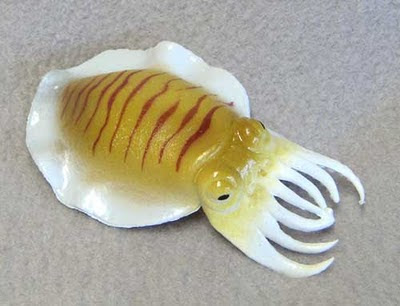
New Plastic Cuttlefish Toy

Plastic Cuttlefish We're very excited to have a new cuttlefish in the store! We once had a cuttlefish that we liked very much, and so did our customers. Unfortunately, as often happens, just when everyone was showing their appreciation by buying them, the old cuttlefish was discontinued by its manufacturer. This often happens because our specialty online store (realistic animals) attracts customers like you who love animals and who appreciate this level of realism in a toy or replica. Not everyone does, and some of the best items are discontinued after only a short "life span." However, we keep on looking and finding the plush and plastic animals that please us and our customers, too!

Our Plastic Squirting Cuttlefish

This realistic-looking plastic cuttlefish squirts water from a tiny hole just below its eyes. It is light weight, squeezable, and looks a lot like the real thing. Although the tentacles are flexible, they are not posable. This plastic cephalopod is great for school projects, toys, novelties, animal collections, party favors and more. Our plastic cuttlefish is for decoration or play only. Although it floats, it should NOT be put in your aquarium with living fish. However, you can make an awesome sea-life or aquarium shoebox diorama using this and other plastic aquatic creatures and mammals, sharks, fish, sea turtles, birds, and decor from our gift shop.

About Cuttlefish

Cuttlefish, of which there are about 120 different species, are cephalopods. They are related to octopi, squid, and nautiluses. They are not fish, but are molluscs (or mollusks) and derive the name "cuttle" from an old German word meaning "pouch." Their bodies are composed of two long sucker-laden tentacles which are used to grab and secure prey - generally worms, small molluscs, crabs, shrimp and, unfortunately, other cuttlefish. Like other invertebrates and cephalopods, cuttlefish have a large internal shell (the cuttlebone) and two extraordinary w-shaped eyes, which, according to many scientists, are among the most developed in the animal kingdom. Although they can't see color, they distinguish contrast in great detail. Their eyes can work independently and one can look backwards as the other looks forward. As the eyes are fully developed at birth, it is thought that before hatching, cuttlefish eggs learn to recognize their future prey. Cuttlefish are found in warmer tropical waters, but not in the Americas. They use camouflage, rapid color change, and ink to communicate and to protect themselves from their many predators such as fish, sharks, dolphins, seals, and other cuttlefish.

Come see our new plastic squirting cuttlefish! In fact, take a few home for yourself or the kids. We ship anywhere!

This blog is sponsored by Tapir and Friends Animal Store.

Wednesday, June 18, 2014

Plastic Snakes to Keep Pests Out of Your Pool and Garden

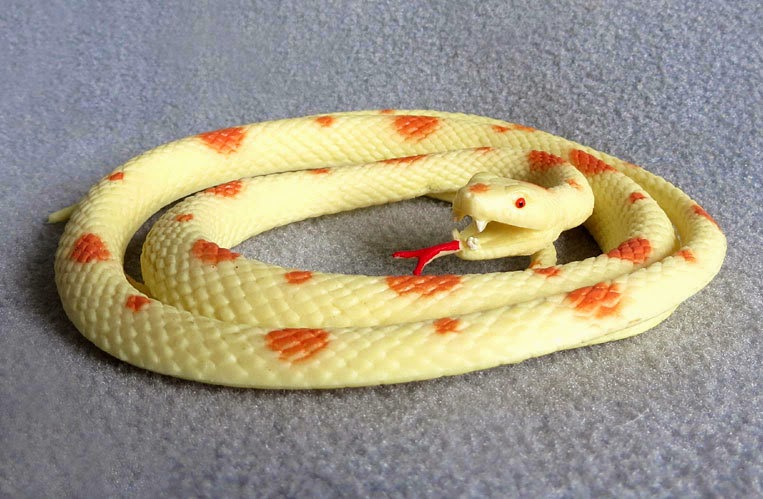
Toy Plastic Orange and Yellow Snake
Plastic Orange Snake with Yellow Bands 
at Tapir and Friends Animal Store

Customers have told us that the best things they ever found to keep birds and other animals away from their swimming pools are fake plastic snakes. These coiled toy snakes might be just the ticket to keep summer pests away. The colors are eye-catching, and the built-in coils allow you to wrap the snakes around bushes or trees in your yard. Our plastic snakes come in a variety of colors and are 40 inches long, although they will not stay stretched out, but will return to a coiled position or wrap nicely around a post or landscaping. Our plastic snakes are very flexible and are fairly realistic looking except for the rather bright colors. If I were a bird, I don't think I would take any chances!

Toy Green Snake

Toy Cream and Orange-Colored Snake

Coiled Yellow Snake Toy

This blog is sponsored by Tapir and Friends Animal Store.

Wednesday, August 17, 2011

Plastic Dyeing Poison Frog


This Plastic Dyeing Poison Frog is so colorful and realistic!

Our plastic dyeing poison frog is one of several brightly-colored realistic plastic frogs to be found at Tapir and Friends. This plastic frog makes a wonderful educational toy or demonstration, is useful for shoebox dioramas and other school projects, can be a collector's item, a gift for your favorite frog fan, and more. Made of solid, rubbery plastic, it measures 1 3/4 inches long and is somewhat flexible. The plastic is solid, but not hard. Its underside is the same bright yellow as the markings on top, and the name "Dyeing Poison Frog" is moulded into the plastic. Be sure to see our other cool frog toys and gifts.

There are many species of brightly-colored poison frogs. We could not find the color variation shown here, but if you can find a picture of the real one for us, we'll send you one of the plastic variety. This interesting description of poison frogs comes from Wikipedia: "The poison dart frog (also poison arrow frog, dart frog or poison frog) is the common name given to the group of frogs belonging to the family Dendrobatidae. Poison dart frogs are native to Central and South America. The frogs are widely called poison arrow frogs or poison dart frogs, reflecting the widespread notion that the frogs are used by South American tribes in the manufacture of poison that is spread on arrows or blow-gun darts. Dart frogs are not poisonous in captivity. Scientists believe that this is due to the fact that they do not receive alkaloids as food because they are fed with cultured insects. These frogs are some of the world's most poisonous living organisms; one drop of poison could be powerful enough to kill 80 people." These frogs live in Central America and northern South America.

This blog is sponsored by Tapir and Friends Animal Store.

Monday, December 7, 2009

Goat plastic animal

Our next new plastic farm animal is a Nanny goat. She's small and perfect for a shoebox diorama or a model farm. Some model railroaders like to use our small plastic animals for just such projects.

Our Plastic Nanny Goat

Our plastic domestic nanny goat is just a fraction under 2 inches from nose to tail, and stands 1 5/8 inches tall. Made of white plastic, and painted two shades of brown, this plastic goat would be great fun for a miniature farm, model train layout, school project, farm diorama, Christmas manger scene, or used as a toy or collectible plastic animal. Check out our other goat toys and gifts.

About Goats

The domestic goat (Capra aegagrus hircus) is a subspecies of goat domesticated from the wild goat of southwest Asia and Eastern Europe. The goat is a member of the Bovidae family and is closely related to the sheep. Both sheep and goats are in the goat-antelope subfamily Caprinae. There are over three hundred distinct breeds of goat. Goats are one of the oldest domesticated species. Goats have been used for their milk, meat, hair, and skins over much of the world. In the twentieth century they also became popular as pets. Goat meat from younger animals is called kid or cabrito, and from older animals is sometimes called chevon, or in some areas “mutton,” although mutton is usually refers to the meat of grown sheep. Female goats are referred to as does or nannies. The term "Nanny goat" originated in the 1700s. Males as bucks or Billies, and the term "Billy goat" originated in the 1800s. The babies and young goats are called "kids." Both males and females can have horns, although horns are not found in every variety of Nanny goats. Goats are ruminants with four-chambered stomachs like cows. Goats have strange-looking eyes, with light-colored horizontal pupils; the irises are usually pale, so the eyes are easier for us to see than in many hoofed animals. The unusual shape of the eye increase peripheral depth perception. Both Nanny and Billy goats have beards, and a goat can live between about 13 and 18 years.

Monday, April 20, 2009

Plastic turtle new in our gift shop

Toy turtle: Freshwater turtle made of plastic This is the first real (plastic) fresh-water turtle we've had in stock, and it's brand new to us this week! We have a large number of sea turtle toys and gifts in our shop (mostly plastic, but a few other kinds, too), and we've had a plastic box turtle for some time.

Our Plastic Toy Freshwater Turtle

This engaging, realistic-looking plastic freshwater turtle miniature is made of somewhat flexible plastic. This replica has a detailed shell and is painted drab green-gray. It may be a kind of pond turtle, but indigenous to China. This freshwater turtle makes for a nice pet, fits into a shoebox diorama, or serves as a great a collectible. Check out our other turtle toys and gifts.

About Freswhwater Turtles

There are about 46 species of freshwater turtles in North America. There is terrific diversity in size, diet, habitat and clutch size among freshwater turtles. All are threaten by loss of habitat, capture for meat, and by predators such as cars and raccoons. A freshwater turtle's shell is commonly called a carapace which is divided into scutes, while the bony belly plate is the plastron. Some freshwater turtles, such as the Western pond turtle, are good to keep in ornamental ponds while others, such as the snapping turtle, are a liability. Some turtles bask for long periods on floating debris while others, like the mud turtle, remain underwater for long periods of time. Freshwater turtles come in various colors of green, brown and dark yellow and each species has a different pattern on its back. The most common freshwater turtle is the painted turtle and is the ideal turtle for a turtle pond.

Friday, December 17, 2010

Grrrr! Do you know anyone who loves lions? Our plastic lion replica may be for them!


This lovely plastic lion replica looks to me like an Atlas lion with a dark mane. It's quite an exotic creature! 

This beautifully detailed plastic lion replica is almost 6 1/2 inches from the tip of its nose to the end of its tail. The body and mane have a fur-like pattern. It's made of sturdy plastic and is very durable. This plastic big cat is great for school projects, toys, novelties, animal collections, party favors and more. Our plastic lion is for decoration or play only. You can make an interesting African shoebox diorama using this and other plastic creatures from our gift shop.

Our plastic animals of a similar size and detail include giraffe, cheetah, lion, hippo, warthog, and elephant. Be sure to check out our other lion toys and gifts.

This blog is sponsored by Tapir and Friends Animal Store.

Friday, November 25, 2011

Plastic Lehmann's Poison Frog


Who knew such a cute little frog could be so lethal?

Our Plastic Lehmann's Dart Frog


Our plastic Lehmann's poison frog is one of several brightly-colored realistic plastic frogs to be found at Tapir and Friends. This plastic frog makes a wonderful educational toy or demonstration, is useful for shoebox dioramas and other school projects, can be a collector's item, a gift for your favorite frog fan, and more. Made of solid, rubbery plastic, it measures 2 1/8 inches long and is somewhat flexible. The plastic is solid, but not hard. Its underside is orange, and the name "Lehmann's Poison Frog" is moulded into the plastic. Be sure to see our other cool frog toys and gifts.

About Lehmann's Dart Frogs


In Spanish, the Lehmann's Dart Frog (Dendrobates lehmanni) is called "Rana venenosa de Lehmann." It is only known definitely from two small locations in Colombia which comprise an area of only 10 km2. Its distribution is severely fragmented and the habitat is becoming more and more degraded. The frog is still common in its tiny range, but is threatened by agricultural development, illegal crops, logging, pollution, settlement, and capture for the pet trade. Locally, indigenous people use the poison to coat darts for killling monkeys.

This blog is sponsored by Tapir and Friends Animal Store.

Thursday, August 6, 2009

New plasic sea life and sea life accessories

Toy Plastic Coral Replica PLEASE NOTE that these plastic replicas are not made to be put in the tank with your live fish. You can use them as toys or to decorate a fake fish tank with fake fish. A lot of people use our plastic sealife replicas as decor for parties or as part of shoebox dioramas for school ecology projects.

Above is our new plastic coral, which could be part of a coral reef display.

Toy Plastic Scuba Diver Next comes our plastic model scuba diver. And what might he or she be looking for besides fish?

Toy Plastic Treasure Chest How about a nice plastic treasure chest? All of these sea life toys can be found on our Aquatic page at Tapir and Friends Wildlife world. You'll also find lots of other sea creatures on this page. Fish and sharks also abound in our store, and can be found by following links from the Aquatic page.

Thursday, November 15, 2012

*SPECIAL!! 50 HORSES*


Get a special rate on a WHOLE HERD!!

SPECIAL! BULK RATE ON PLASTIC HORSES!!


Come see our list of fantastic bulk packages! Our featured special today is a WHOLE HERD of miniature plastic horses...great for toys or a class project!

I don't know if you'd call our plastic horse figurine a chestnut, a buckskin, or what. If you have the answer, please let us know! However, since our model horse is made of plastic, it's probably OK for it to be a beautiful eye-catching warm pumpkin color. The black legs and tail add a striking finish to this nice plastic toy. Our plastic horse is 3 1/4 inches long when measured from its nose to the end of its tail. It stands up nicely to a height of 2 1/4 inches to the tips of its black ears, and about 2 1/2 inches from the ground to its back. Our plastic horse has met all of the new U.S. child safety standards for children's toys in both the plastic and paint categories. Check out our other horse toys and gifts.

About Horses


There is so much to say about horses, that it's hard to know where to start. In fact, I think we'll just give a brief overview. Horse information is very easy to find on the web, and we all know basically what a horse is. As with any animal, once you delve into the fascinating details, you can always learn more. The horse (Equus caballus) is a hoofed mammal, and all hoofed mammals are called ungulates. The horse is an odd-toed ungulate in the family Equidae, and has one toe on each foot. In the case of the horse, the one toe has become very large so that we hardly think of it as a toe. The odd-toed animals, Order Perissodactyla, include only 17 species, which is fewer than the other order, even-toed ungulates (Artiodactyla). In the Order Perissodactyla we find horses, zebras, donkeys, and other animals that resemble horses, but the order also includes tapirs and rhinos. All other hoofed animals such as deer, cows, and hippos, have either two or four toes on each foot. The horse has evolved over the past 45 to 55 million years from a small multi-toed creature into the large, single-toed animal of today. Horses are one of the animals for which we have the most complete fossil record, which makes it interesting to study their evolution. Humans began to domesticate horses around 4,000 BC, and their domestication is believed to have been widespread by 3,000 BC. Just think of all the ancient art and statuary that depict the relationship between horses and humans! By 2,000 BC, the use of domesticated horses had spread throughout the Eurasian continent. Although most horses today are domesticated, there are still endangered populations of the Przewalski's Horse, the only remaining true wild horse, as well as more common feral horses which live in the wild but are descended from domesticated ancestors. Horse breeding is a very specialized area of expertise, and many breeds have been developed, each with their own characteristics of color, conformation, abilities, shapes and sizes.

This blog is sponsored by Tapir and Friends Animal Store.

Tuesday, January 3, 2012

Plastic Blue Crab


Loved by millions...with a little lemon and garlic!

Our Plastic Blue Crab


Our plastic blue crab measures 2 inches from side to side. This plastic crustacean is one of our series of lively and lifelike plastic animals. Its realistic shape and details will be enjoyed as part of a school project, diorama, plastic animal collection, as a party favor, or gift. Our plastic crab toy is for decoration or play only. It does not float, and should NOT be put in your aquarium. However, you can make an interesting sea-life or aquarium shoebox diorama using this and other plastic aquatic creatures and mammals, sharks, fish, sea turtles, birds, and decor from our gift shop. There is no mess, no feeding, and no tank cleaning :) Be sure to look over our other crab toys and gifts.

About Blue Crabs


Although there are over 50 crab families and 1000s of species, all crabs have basically the same body plan: four pairs of walking legs and one pair of claws (also called nippers or pincers). Their shell is actually their skeleton, called an exoskeleton, and protects their thorax, gills and the internal organs of the head. Like the octopus and sea star, if the crab loses a limb it will regenerate (grow back).
Atlantic blue crabs (Callinectes sapidus) are found in the Gulf of Mexico, the Pacific coast of Central America, and the western waters of the Atlantic Ocean. While ignored as a food source in Central America, Atlantic blue crabs are fished extensively along the north Atlantic states of the United States. Atlantic blue crabs are the state crustacean of Maryland. In addtition to humans, Atlantic blue crabs are preyed upon by eels, sharks, trout, bass, and other fish. Atlantic blue crabs are omnivores, feeding on virtually anything smaller than themselves, including other blue crabs and carrion.

This blog is sponsored by Tapir and Friends Animal Store.

Thursday, December 10, 2009

Donkey plastic replica or toy - new in our online store

Toy Plastic Donkey This cute donkey plastic replica is brand new in our store!

Our Plastic Donkey

Our plastic toy donkey looks a little surprised! It adds character to this little figuine, and could help him look more animated in a diorama or in a toy farm setting. Our plastic donkey is 2 1/2 inches long when measured from its nose to the end of its tail. It stands up nicely to a height of 1 7/8 inches to the tips of its ears, and about 1 3/8 inches from the ground to its rump. This donkey would be perfectly happy to be used in a farm diorama, as a toy, a collectible animal, in a Christmas manger scene, or as a pack animal. In that case, you can use your own imagination to create the pack and supplies. Our plastic donkey has met all of the new U.S. child safety standards for children's toys in both the plastic and paint categories. Check out our other donkey toys and gifts.

About Donkeys

The donkey (Equus africanus asinus) is a domesticated member of the Equidae or horse family, and an odd-toed ungulate. Originally donkeys derived from their wild cousins in Africa. In the western United States, a small donkey is sometimes called by its Spanish name: "burro." While different species of the Equidae family can interbreed, offspring are almost always sterile. Nonetheless, horse/donkey hybrids are popular for their durability and vigor. A mule is the offspring of a jack (male donkey) and a mare (female horse). The much rarer successful mating of a male horse and a female donkey produces a hinny. The domesticated donkey was first seen about 3,000 BC, approximately the same time as the horse, and they have spread around the world. Donkeys have been used for centuries as beasts of burden to carry people as well as supplies, as well as companion animals. Donkeys are rugged and sure-footed in difficult terrain and on narrow trails, which has added to humans' dependence on these animals. Think of the miner and his donkey, or the people of Asia traveling long distances. Donkeys were commonly used in Europe in Medieval times. They continue to fill important roles in many places today and domesticated species are increasing in numbers. However, some of their wild relatives such as the onager, are endangered.

Thursday, April 12, 2012

Plastic Horse


Saddle up with this fine steed!

Our Plastic Horse


I don't know if you'd call our plastic horse figurine a chestnut, a buckskin, or what. If you have the answer, please let us know! However, since our model horse is made of plastic, it's probably OK for it to be a beautiful eye-catching warm pumpkin color. The black legs and tail add a striking finish to this nice plastic toy. Our plastic horse is 3 1/4 inches long when measured from its nose to the end of its tail. It stands up nicely to a height of 2 1/4 inches to the tips of its black ears, and about 2 1/2 inches from the ground to its back. Our plastic horse has met all of the new U.S. child safety standards for children's toys in both the plastic and paint categories. Check out our other horse toys and gifts.

About Horses


There is so much to say about horses, that it's hard to know where to start. In fact, I think we'll just give a brief overview. Horse information is very easy to find on the web, and we all know basically what a horse is. As with any animal, once you delve into the fascinating details, you can always learn more. The horse (Equus caballus) is a hoofed mammal, and all hoofed mammals are called ungulates. The horse is an odd-toed ungulate in the family Equidae, and has one toe on each foot. In the case of the horse, the one toe has become very large so that we hardly think of it as a toe. The odd-toed animals, Order Perissodactyla, include only 17 species, which is fewer than the other order, even-toed ungulates (Artiodactyla). In the Order Perissodactyla we find horses, zebras, donkeys, and other animals that resemble horses, but the order also includes tapirs and rhinos. All other hoofed animals such as deer, cows, and hippos, have either two or four toes on each foot. The horse has evolved over the past 45 to 55 million years from a small multi-toed creature into the large, single-toed animal of today. Horses are one of the animals for which we have the most complete fossil record, which makes it interesting to study their evolution. Humans began to domesticate horses around 4,000 BC, and their domestication is believed to have been widespread by 3,000 BC. Just think of all the ancient art and statuary that depict the relationship between horses and humans! By 2,000 BC, the use of domesticated horses had spread throughout the Eurasian continent. Although most horses today are domesticated, there are still endangered populations of the Przewalski's Horse, the only remaining true wild horse, as well as more common feral horses which live in the wild but are descended from domesticated ancestors. Horse breeding is a very specialized area of expertise, and many breeds have been developed, each with their own characteristics of color, conformation, abilities, shapes and sizes.

This blog is sponsored by Tapir and Friends Animal Store.

Sunday, September 18, 2011

Plastic Horse Replica


A superb replica of a magnificent animal!

Our Plastic Horse


I don't know if you'd call our plastic horse figurine a chestnut, a buckskin, or what. If you have the answer, please let us know! However, since our model horse is made of plastic, it's probably OK for it to be a beautiful eye-catching warm pumpkin color. The black legs and tail add a striking finish to this nice plastic toy. Our plastic horse is 3 1/4 inches long when measured from its nose to the end of its tail. It stands up nicely to a height of 2 1/4 inches to the tips of its black ears, and about 2 1/2 inches from the ground to its back. Our plastic horse has met all of the new U.S. child safety standards for children's toys in both the plastic and paint categories. Check out our other horse toys and gifts.

About Horses


The horse (Equus caballus) is a hoofed mammal, and all hoofed mammals are called ungulates. The horse is an odd-toed ungulate in the family Equidae, and has one toe on each foot. In the case of the horse, the one toe has become very large so that we hardly think of it as a toe. The odd-toed animals, Order Perissodactyla, include only 17 species, which is fewer than the other order, even-toed ungulates (Artiodactyla). In the Order Perissodactyla we find horses, zebras, donkeys, and other animals that resemble horses, but the order also includes tapirs and rhinos. All other hoofed animals such as deer, cows, and hippos, have either two or four toes on each foot. The horse has evolved over the past 45 to 55 million years from a small multi-toed creature into the large, single-toed animal of today. Horses are one of the animals for which we have the most complete fossil record, which makes it interesting to study their evolution. Humans began to domesticate horses around 4,000 BC, and their domestication is believed to have been widespread by 3,000 BC. Just think of all the ancient art and statuary that depict the relationship between horses and humans! By 2,000 BC, the use of domesticated horses had spread throughout the Eurasian continent. Although most horses today are domesticated, there are still endangered populations of the Przewalski's Horse, the only remaining true wild horse, as well as more common feral horses which live in the wild but are descended from domesticated ancestors. Horse breeding is a very specialized area of expertise, and many breeds have been developed, each with their own characteristics of color, conformation, abilities, shapes and sizes.

This blog is sponsored by Tapir and Friends Animal Store.

Thursday, December 10, 2009

Plastic horse figurine new in our store

Our Plastic Horse

I don't know if you'd call our plastic horse figurine a chestnut, a buckskin, or what. If you have the answer, please let us know! However, since our model horse is made of plastic, it's probably OK for it to be a beautiful eye-catching warm pumpkin color. The black legs and tail add a striking finish to this nice plastic toy. Our plastic horse is 3 1/4 inches long when measured from its nose to the end of its tail. It stands up nicely to a height of 2 1/4 inches to the tips of its black ears, and about 2 1/2 inches from the ground to its back. Our plastic horse has met all of the new U.S. child safety standards for children's toys in both the plastic and paint categories. Check out our other horse toys and gifts.

About Horses

There is so much to say about horses, that it's hard to know where to start. In fact, I think we'll just give a brief overview. Horse information is very easy to find on the web, and we all know basically what a horse is. As with any animal, once you delve into the fascinating details, you can always learn more. The horse (Equus caballus) is a hoofed mammal, and all hoofed mammals are called ungulates. The horse is an odd-toed ungulate in the family Equidae, and has one toe on each foot. In the case of the horse, the one toe has become very large so that we hardly think of it as a toe. The odd-toed animals, Order Perissodactyla, include only 17 species, which is fewer than the other order, even-toed ungulates (Artiodactyla). In the Order Perissodactyla we find horses, zebras, donkeys, and other animals that resemble horses, but the order also includes tapirs and rhinos. All other hoofed animals such as deer, cows, and hippos, have either two or four toes on each foot. The horse has evolved over the past 45 to 55 million years from a small multi-toed creature into the large, single-toed animal of today. Horses are one of the animals for which we have the most complete fossil record, which makes it interesting to study their evolution. Humans began to domesticate horses around 4,000 BC, and their domestication is believed to have been widespread by 3,000 BC. Just think of all the ancient art and statuary that depict the relationship between horses and humans! By 2,000 BC, the use of domesticated horses had spread throughout the Eurasian continent. Although most horses today are domesticated, there are still endangered populations of the Przewalski's Horse, the only remaining true wild horse, as well as more common feral horses which live in the wild but are descended from domesticated ancestors. Horse breeding is a very specialized area of expertise, and many breeds have been developed, each with their own characteristics of color, conformation, abilities, shapes and sizes.

Saturday, November 24, 2012

Plastic Fat-tailed Scorpion


Not many of THESE in the Oregon Coast Range! WHEW!!

Our Plastic Fat-Tailed Scorpion Replica


Our plastic fat-tailed scorpion is an interesting toy or replica. Look at the lifelike detail. The body is dark, and you can see the reddish hue on the pincers, distinguishing it from other plastic scorpions. It also has a square, bulky tail. The exact shape is hard to see in this photo, but it makes this scorpion somewhat unique. Wouldn't our plastic fat-tailed scorpion be perfect in a diorama for a school project about scorpions, venomous animals, or various desert regions of the world? It also makes a superb educational toy. The fat-tailed scorpion has many realistic details that can teach children about arachnids, and it is flexible to minimize scratches to humans, so it can be used as a durable toy as well. This plastic scorpion can be held in your hand and we promise - it will not sting! The fat-tailed scorpion can be used to enhance reports at school, can be used by therapists for sand trays, or just carry the scorpion around in your pocket to entertain your friends. Check out our other scorpion and arachnid toys, gifts, and lifelike replicas.

About Fat-tailed Scorpions


Scorpions are found in warm regions. They are arachnids, and therefore more closely related to spiders than to insects. They are found not only in the desert, but also in forests. They spend much of the day under logs and leaf litter, and feed mostly at night on spiders and insects. Most scorpions are only painful to humans and are not especially dangerous, although a few can deliver a fatal sting. Children and elderly people are more at risk from their venom than strong, healthy adults. The approximately 2,000 species of scorpion vary widely in size, from about 1/2 inch to 7 inches long. Our plastic scorpion is most likely an artistic version of the Arizona desert scorpion (Hadrurus arizonensis pallidus), characterized by a dirty light brown/yellow color and a black to brown streak on its back. People have collected scorpions and made a commercial product out of them in the form of paperweights and keychains by placing them inside moulded plastic. Because of this, they have become over-collected and are now "a CITES-listed animal, meaning scorpions could be threatened with extinction if exportation and other threats, such as development, are not regulated." [Wikipedia]

Fat-tailed scorpions are found in the arid and semi-arid regions of the Middle East and North Africa. The neurotoxin venom of this 4-inch-long scorpion can be fatal to humans, causing several deaths each year.

This blog is sponsored by Tapir and Friends Animal Store.

Sunday, August 14, 2011

Plastic Helmet Crab


Our Plastic Helmet Crab is so colorful and would be a great addition to any collection.

Our helmet crab is made of hard plastic and measures 2 3/8 inches from side to side and 1 5/8 inches from front to back. Its name is moulded into the underside. This plastic crustacean is one of our series of lively and lifelike plastic animals. Its realistic shape and details will be enjoyed as part of a school project, diorama, plastic animal collection, as a party favor, or gift. Our helmet crab toy is for decoration or play only. It does not float, and should NOT be put in your aquarium. However, you can make an interesting sea-life or aquarium shoebox diorama using this and other plastic aquatic creatures and mammals, sharks, fish, sea turtles, birds, and decor from our gift shop. There is no mess, no feeding, and no tank cleaning :) Come see our wonderful assortment of crab toys and gifts.

Although there are over 50 crab families and 1000s of species, all crabs have basically the same body plan: four pairs of walking legs and one pair of claws (also called nippers or pincers). Their shell is actually their skeleton, called an exoskeleton, and protects their thorax, gills and the internal organs of the head. Like the octopus and sea star, if a crab loses a limb it will regenerate (grow back).


This blog is sponsored by Tapir and Friends Animal Store.

Monday, February 20, 2012

Plastic Dragonfly


Nature's answer to the helicopter!

Our Plastic Dragonfly


This engaging, realistic-looking plastic dragonfly is made of hard, flexible plastic. It is 2 1/2 inches long and 2 1/4 inches across from wing-tip to wing-tip. Our plastic dragonfly has clear plastic, detailed wings and a red and yellow segmented body. We don't know what kind of dragonfly our plastic dragonfly replicates, but if you do, please e-mail us. It works well for a shoe box diorama or other school projects. It also makes for an interesting party favor or for a gag. Check out our other dragonfly toys and gifts.

About Dragonflies


A dragonfly is an insect belonging to the order Odonata. It is has large multifaceted eyes, two pairs of strong, transparent wings, and an elongated body. Dragonflies eat mosquitoes, midges, and other small insects like flies, bees, and butterflies. They are valuable predators, since they help control populations of harmful insects. Dragonflies are usually found around lakes, ponds, streams and wetlands because their larvae, known as "nymphs", are aquatic. Dragonflies do not normally bite or sting humans, though they will bite in order to escape, if grasped by the abdomen. Dragonflies hover above the water, but then can rapidly accelerate. They capture their prey by clasping them in legs studded by spikes. We are most familiar with the adult stage of the dragonfly, but most of their life is spent as a nymph below the water.

This blog is sponsored by Tapir and Friends Animal Store.

Saturday, May 12, 2012

Plastic Dragonfly


Before dinosaurs, these guys were THREE FEET LONG!!

Our Plastic Dragonfly


This engaging, realistic-looking plastic dragonfly is made of hard, flexible plastic. It is 2 1/2 inches long and 2 1/4 inches across from wing-tip to wing-tip. Our plastic dragonfly has clear plastic, detailed wings and a red and yellow segmented body. We don't know what kind of dragonfly our plastic dragonfly replicates, but if you do, please e-mail us. It works well for a shoe box diorama or other school projects. It also makes for an interesting party favor or for a gag. Check out our other dragonfly toys and gifts.

About Dragonflies


A dragonfly is an insect belonging to the order Odonata. It is has large multifaceted eyes, two pairs of strong, transparent wings, and an elongated body. Dragonflies eat mosquitoes, midges, and other small insects like flies, bees, and butterflies. They are valuable predators, since they help control populations of harmful insects. Dragonflies are usually found around lakes, ponds, streams and wetlands because their larvae, known as "nymphs", are aquatic. Dragonflies do not normally bite or sting humans, though they will bite in order to escape, if grasped by the abdomen. Dragonflies hover above the water, but then can rapidly accelerate. They capture their prey by clasping them in legs studded by spikes. We are most familiar with the adult stage of the dragonfly, but most of their life is spent as a nymph below the water.

This blog is sponsored by Tapir and Friends Animal Store.

Thursday, January 5, 2012

Plastic Fiddler Crab


This replica is actually close to life-size!

Our Plastic Fiddler Crab


Our fiddler crab is made of plastic and measures 2 1/4 inches from side to side and 2 inches from front to back. This plastic crustacean is one of our series of lively and lifelike plastic animals. Its realistic shape and details will be enjoyed as part of a school project, diorama, plastic animal collection, as a party favor, or gift. Our fiddler crab toy is for decoration or play only. It does not float, and should NOT be put in your aquarium. However, you can make an interesting sea-life or aquarium shoebox diorama using this and other plastic aquatic creatures and mammals, sharks, fish, sea turtles, birds, and decor from our gift shop. There is no mess, no feeding, and no tank cleaning :) Check out our terrific selection of crab toys and gifts.

About Fiddler Crabs


Although there are over 50 crab families and 1000s of species, all crabs have basically the same body plan: four pairs of walking legs and one pair of claws (also called nippers or pincers). Their shell is actually their skeleton, called an exoskeleton, and protects their thorax, gills and the internal organs of the head. Like the octopus and sea star, if a crab loses a limb it will regenerate (grow back).

The term "fiddler crab" describes any of approximately 100 species of crab of the genus Uca. Fiddler crabs are characterized by their mismatched claws. The little claw is used for feeding, the motion giving it the appearance of playing a fiddle (the large claw). If a fiddler loses the large claw, the small claw will grow to take its place and the lost claw will regenerate into a new small claw. Fiddler crabs are small, the largest being just over 2 inches across.

This blog is sponsored by Tapir and Friends Animal Store.

You might also like

Related Posts with Thumbnails