Saturday, June 30, 2012

Mud Crab


Looks a little like an 8-legged ninja, don't he?

Our Mud Crab


This engaging, realistic-looking plastic mud crab has a solid body, but flexible legs. It is 2 1/2 inches across with good detail. This crab makes a nice pet, a gift or is useful for a diorama. Check out our other crab toys and gifts.

About Mud Crabs


The most common mud crab (Scylla serrata) is generally a mangrove crab but can also refer to several similar crabs found in mud throughout the world. Some mud crabs are large crabs with a smooth, broad carapace. They have 9 even sized teeth on each side of their eyes. Their two hind legs are flattened for swimming. In the most common form, the color varies from very dark brown/black to mottled green. Mud crabs inhabit sheltered estuaries, the tidal reaches of some rivers, mud flats and mangrove forests. These crabs are found scuttling along a soft, muddy bottom, often below low tide level. Some are harvested commercially especially in Australia but, for the most part, they make excellent bait for larger aggressive fish.

This blog is sponsored by Tapir and Friends Animal Store.

Wednesday, June 27, 2012

Soft Play Latex Giant Panda Replica


A soft and exquisitely-detailed replica of a wonderful animal!

Our Soft Play Plastic Giant Panda


This realistic-looking latex-coated soft play giant panda is a terrific replica. It is 8 1/2 inches long. It is also 4 1/2 inches tall. Our panda replica has a soft plastic "skin" and a squishy inner body possibly made of foam. It is an excellent toy for children because it is light weight and durable, and it's not likely to damage anything by its impact if a child throws it. It serves as an educational toy for a science project or as a gag or unusual gift. Check out our other panda toys and gifts.

About Pandas


The Giant Panda (Ailuropoda melanoleuca) is found in central and southwestern China. It is a member of the bear family and in the order of carnivores,(which implies meat-eating) although, in its natural state, it eats exclusively bamboo shoots. The giant panda has been impacted heavily by encroaching civilization and is considered an endangered species with probably no more than 1500 individuals living in the wild with about 250 animals living in captivity. It is a docile animal and is not known to attack humans. It is slowly replacing the dragon as China's national symbol.

This blog is sponsored by Tapir and Friends Animal Store.

Tuesday, June 26, 2012

Realistic, Flexible Plastic Crayfish


Yummy!!

Our Plastic Crayfish


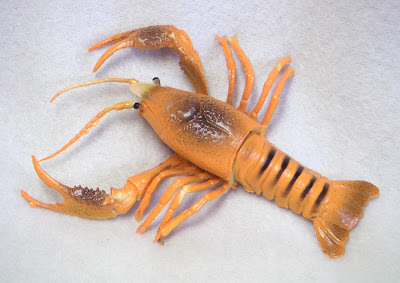
This realistic-looking flexible plastic crayfish replica or toy is made to look a lot like a real crayfish with bendable appendages. And, IT FLOATS! This replica has elaborate detail including tiny little feet and is painted orange with black stripes on the tail and gray detailing on the back, claws, and tail. Its eyes are a beady black that reflect highlights so it appears that the crayfish is actually looking at you! This could be good if you're using it for a diorama or toy, or it could be bad if you're using it for decor at a crayfish bake! Our crawfish has distinct detailing and is 4 1/2 inches long from tail to the tips of its feelers. Our plastic crawdad makes for a nice pet, fits into a shoebox diorama, or serves as a great collectible. This crustacean is for decoration or play only. Even though it floats, it should NOT be put in your aquarium with living fish. Check out our other lobster, shrimp and crayfish toys and gifts.

About Crayfish


Crayfish, crawfish or crawdads are freshwater crustaceans and are related to lobsters. They are a commonly found in running freshwater streams and lake beds where they live in crevices or under rocks. They can not tolerate pollution but feed on dead organic matter and plants. There are numerous species of crayfish widely distributed throughout the world. In such diverse places such as China, Australia, France, Mexico, and Scandanavia, the tail is eaten as a delicacy in soups or bisques or the crawdad is served whole at feeds. No geographical place covets the crayfish more than in Louisiana where the crayfish can be found prepared in any number of Cajun recipes. Since the demand is so high they are farm raised making it an important food crop for the local economy. Not only do humans love crayfish, but they are an excellent bait for bass, muskies and crappie. Unfortunately fishermen have spread crayfish species that compete with native varieties. Crayfish also make lovely pets and can be kept in freshwater aquariums.

 This blog is sponsored by Tapir and Friends Animal Store.

Monday, June 25, 2012

Stuffed Hyena


One of the most unique stuffed animals you'll find!

Our Plush Hyena


Our stuffed hyena is lifelike and sturdy. Hansa prides itself on making lifelike animals of near-custom quality and design. The materials are made to order for small-run series of your favorite animals. Our stuffed spotted hyena measures 14 inches from nose to rump and stands 8 1/2 inches tall at the shoulder. Its nose is made of moulded hard plastic and looks very real. The eyelids are also made of plastic, giving a lifelike aspect to the face. See our other hyena toys and gifts as well as our collection of Hansa stuffed animals.

About Hyenas


One might think that hyenas are related to dogs, but they are actually in a separate biological family most closely related to meerkats and mongooses. Hyenas have among the strongest jaws in the animal world. According to Wikipedia, "The Spotted Hyena, or Laughing Hyena, (Crocuta crocuta) is a mammal of the order Carnivora. They are moderately large, terrestrial carnivores native to Africa. They are best known for a chirping, birdlike bark that resembles the sound of hysterical human laughter. Though often labeled incorrectly as a scavenger, the spotted hyena is actually a powerful hunter, the majority of its nourishment being derived from live prey. Spotted hyenas are the most common predator in sub-saharan Africa, living in savannah, dry woodland and desert habitats."

This blog is sponsored by Tapir and Friends Animal Store.
Sunday, June 24, 2012

Plastic Velociraptor


One of my son's favorite dinosaurs!

Our Plastic Velociraptor


Remember the scary (and fast!) velociraptors in Steven Spielberg's "Jurassic Park"? Bring a slice of the movie home to your own house, school, or dinosaur collection. Made of hard plastic, this fierce-looking velociraptor will add color and flash to your diorama, school project, or collection. This dinosaur is part of Safari, Ltd's famous museum-quality "Carnegie Collection" of prehistoric life. Its details are great for teaching youngsters about extinct animals or just for your own enjoyment. Priced affordably, the velociraptor can also be used as a toy, novelty, party or theme decor, etc. It measures 7 1/4 inches from teeth to tail.

About the Velociraptors


The velociraptor, or "speedy raider," lived in the Cretaceous period in what is now Mongolia. It was a two-legged, feathered carnivore with a long, stiffened tail and an enlarged sickle-shaped claw on each hindfoot, which is thought to have been used to kill its prey. The velociraptor was popularized in the movie Jurassic Park, but it was made much larger and without feathers. The velociraptor was really only the size of a turkey, but nontheless ferocious.

This blog is sponsored by Tapir and Friends Animal Store.

Thursday, June 21, 2012

Beaded Unicorn Keychains from Guatemala


Some animals are even more endangered than tapirs!

Our Beaded Unicorn Keychains


The beading on these unicorn animal keychains is securely stitched into a woven fabric of beads and is very sturdy. Unlike some beaded animals I've seen that are beautiful and engaging but very delicate, these unicorns are durable and with normal handling will hold up extremely well. Check out our other unicorn items as well as our page of beaded animals and beaded keychains from Guatemala. When you purchase one of these unique animals from our collection, you help in a number of ways. You help save tapirs, because that's what we do. You help the local artisans in Guatemala who need an outlet for their work (yes, jobs!), and you help my new friend Catherine with her sustainable business of working with the artisans of Guatemala to maintain jobs for themselves and make beautiful art for many people around the world to enjoy.

About Unicorns


One of history's most recognized fantasy creatures, the unicorn was first mentioned by the ancient Greeks and became the most important imaginary creature of Europe during the Middle-Ages. Like many mythological creatures (the manticore, the griffin, and the sphinx to name a few), the unicorn is a combination of existing animal traits, combining the horn of a narwhal, the hooves and beard of a goat, the body of a horse or deer, and the tail of a lion or ox.

Many Biblical passages mention the unicorn, and unicorns appear in many Renaissance scientific journals. The horn of the unicorn is of 'Alicorn', a substance with powerful purification and medicinal qualities. Of course, Alicorn does not exist in nature, but false Alicorn powder (usually comprised of powdered tusks and antlers from many different animals) was commonly sold in Europe as late as the mid 1700's for curing many diseases and detecting and counteracting poisons. In addition, goblets made of alicorn (usually ivory) were sold and gifted to European nobility for their ability to nullify poisons in drink.

This blog is sponsored by Tapir and Friends Animal Store.

Plush Hippo Stage Puppet


How cute is THAT!?!

Our Plush Hippo Stage Puppet


Our very cute and lovable plush hippo stage puppet is 19 inches long and is crafted with fine workmanship from Folkmanis. It is 7 inches tall and has a 3 inch tail. It is with incredibly soft fabric and has realistic features. Your hand goes inside the hippo puppet's chest and works the mouth, so it can stand on your arm or on a puppet stage. It has shiny black eyes, soft plastic non scratchy tusks, and its whiskers are made of tufts of soft dark gray thread. Our hippo hand puppet makes for an enjoyable toy or pet or educational toy or fits nicely into a hippo collection. This stuffed hippo hand puppet may work well for school projects. Be sure to see our other hippo toys and gifts.

About Hippos


The hippopotamus (Hippopotamidae) spends most of its life in the rivers and lakes of Africa. Hippopotamus babies are born and nursed in the water. Adult hippos are dangerous and often engage in vicious fights with each other. As hippo expert Hans Klingel once noted, "Few animals are as recognizable as the hippopotamus." Indeed, it is almost impossible to mistake a hippopotamus for anything else. The body is long, barrel-shaped, and very deep. (I always thought they were more potato-shaped.) The limbs are short and pillar-like, with four toes on each foot. The hippo's neck is short and quite thick in order to support the weight of the massive head. The ears are small and round, the eyes are bulbous and protruding, and the muzzle is broad and rounded. The hippo's mouth is especially large; in fact, the hippo can open its mouth wider than any other living animal except the whales. The upper and lower canine teeth - often referred to as tusks - are long, thick, and very sharp. The animal has no hair except for a few stiff bristles on its muzzle, ears, and stubby tail. The skin color ranges from slate gray to copper brown on the back to pinkish purple on the belly and around the ears and eyes.

This blog is sponsored by Tapir and Friends Animal Store.

Wednesday, June 20, 2012

Plastic Scorpion


NOT something I wanna see running across my bathroom floor!

Our Plastic Scorpion


Our realistic-looking plastic desert scorpion is made of solid plastic, and measures 2 1/2 inches from the end of its pincers to the curve in its tail. The stinger at the end of the tail is dark brown, as is its back and the tips of its pincers. This plastic scorpion can be used as an educational toy, as part of a shoebox diorama or other school project, as a collector's item, an inexpensive gift for your favorite scorpion fan, and more. It is flexible, and is in an active striking pose. Be sure to see our other scorpion toys and gifts.

About Scorpions


Scorpions are found in warm regions. They are arachnids, and therefore more closely related to spiders than to insects. They are found not only in the desert, but also in forests. They spend much of the day under logs and leaf litter, and feed mostly at night on spiders and insects. Most scorpions are only painful to humans and are not especially dangerous, although a few can deliver a fatal sting. Children and elderly people are more at risk from their venom than strong, healthy adults. The approximately 2,000 species of scorpion vary widely in size, from about 1/2 inch to 7 inches long. Our plastic scorpion is most likely an artistic version of the Arizona desert scorpion (Hadrurus arizonensis pallidus), characterized by a dirty light brown/yellow color and a black to brown streak on its back. People have collected scorpions and made a commercial product out of them in the form of paperweights and keychains by placing them inside moulded plastic. Because of this, they have become over-collected and are now "a CITES-listed animal, meaning scorpions could be threatened with extinction if exportation and other threats, such as development, are not regulated." [Wikipedia]

This blog is sponsored by Tapir and Friends Animal Store.

Plastic Tapir Replica


A magnificent replica of our favorite mammal!

Plastic Asian (Malayan) Tapir


Our plastic museum-quality version of the Asian or Malayan tapir has the markings of a real tapir. The "saddle" which extends from its shoulder to its rump, the white rimmed ears, and the remaining black hair covering the legs, chest, and head mimic the pattern designed for camouflage. The plastic Asian tapir measures 4 1/4 inches in length, and 2 1/2 inches high. The realistic "floppy" snout, four-toed front and three-toed back feet (with a little hoof at the end of each toe) help make this the most realistic toy tapir we've ever seen. Other features include the white rims around each small hoof and the strongly chiseled indentation of the face muscles. Even the nostrils appear to flatten as they do in a real tapir. It even has short markings in the plastic indicating its fur coat. This delightful model will complete your diorama or please any tapir collector or collector of animal figurines. You may already be familiar with the quality produced by Safari, Ltd. This sturdy piece will also withstand handling and playtime. See our entire collection of tapirs.

About Asian (Malayan) Tapirs


Malayan tapirs (Tapirus indicus) grow to between 6 and 8 feet in length, stand 3 to 3.5 feet tall, and typically weigh between 550 and 700 pounds. Like the other types of tapir, they have small stubby tails and long, flexible proboscises. They have four toes on each front foot and three toes on each back foot. The Malayan Tapir has rather poor eyesight but excellent hearing and sense of smell. The easily identifiable markings (the saddle, white rimmed ears, black legs, chest, and head) make it more difficult to recognize it as a tapir, and other animals may mistake it for a large rock rather than a form of prey when it is lying down to sleep. Malayan Tapirs communicate with high-pitched squeaks and whistles. They usually prefer to live near water and often bathe and swim, and they are also able to climb steep slopes. Malayan Tapirs can live up to 30 years, both in the wild and in captivity. Malayan tapirs live in Southest Asia, where they have become extinct in some of their range; small populations still survive in Myanmar, Thailand, and Sumatra (Indonesia). In the past, scientists believed that tapirs live solitary lives, but in recent years, it has become clear that they can be found in small family groups. They do not live in herds, and are hard to located in the forest. Under ideal conditions, a tapir gives birth about every 18 months to two years, bearing only one calf at a time. The slow "recruitment rate" is one of the several reasons they are on their way to extinction. Read more about Malayan tapirs here.

This blog is sponsored by Tapir and Friends Animal Store.

Tuesday, June 19, 2012

Plastic Aardvark


Don't worry...we all have red eyes in photos!

Our Plastic Aardvark


Our plastic aardvark is made of slightly flexible hard plastic and measures 4 inches from nose to tail. This aardvark is part of a series of plastic toys that is hollow, allowing for a little flexibility. It is also very strong. The features such as the fur, hooves, and lips are well defined and easy to see. Its name ("AARDVARK") is moulded into the underside of the toy. This plastic aardvark is great for school projects, toys, novelties, animal collections, party favors and more. You can make an interesting shoebox diorama using this and other plastic creatures from our gift shop. Best of all, there is no mess, no feeding, and no tank or cage cleaning :) Be sure to look over our other aardvark toys and gifts.

About Aardvarks


Aardvarks (Orycteropus afer) are African mammals of a medium size that are most active at night and are good at burrowing into the earth. Their name, "aardvark," comes from the Afrikaans/Dutch language and means "earth pig." This unusual-looking animal has many names locally, including "antbear" or "anteater," although it is not a close relative of the anteaters of South America. Neither is it closely related to a pig, but is somewhat isolated taxonomically and is the only member of the order Tubulidentata. It is not a true edetate, although we've listed it with our edentates on the web site so that people could find it. As odd as it sounds, the aardvark is most closely related to elephant shrews, hyraxes, tenrecs and elephants. If we had put the aardvark in our elephant category, would you have found it? It's a strange thought!

This blog is sponsored by Tapir and Friends Animal Store.

Bushbaby Stuffed Animal


An amazing and unique stuffed animal!

Our Stuffed Bushbaby


Our exceptionally soft, cuddly stuffed bushbaby by Fiesta measures 9 inches not including its extremely long tail. The eyes, ears, legs and tail are securely attached making this charming stuffed animal a suitable toy for all ages. To find our other animals in the Fiesta line, or see a list of our entire inventory of stuffed animals, beanies and puppets or check out our other bushbaby toys and gifts.

About Bushbabies


Like lemurs, bushbabies are prosimians, primates that are not as highly evolved as monkeys or great apes. Also called galagos and nagapies (Afrikaans for "night monkeys"), these small, nocturnal creatures are native to continental Africa. Their name comes from the animals' cries which sound much like a crying baby. Their strong hind legs, which are longer than their front legs, make them agile leapers. Their large eyes give them good night vision and their long tails help them balance. Their paws are remarkably like a human's hand with 4 fingers and a thumb.

This blog is sponsored by Tapir and Friends Animal Store.

Monday, June 18, 2012

Plastic Queen Triggerfish


What a dazzling miniature! A remarkable addition to any collection!

Our Plastic Queen Triggerfish


This beautiful, realistic-looking queen triggerfish replica is made of solid plastic with flexible fins. The body together with the solid part of the fins is 4 7/8 inches long, but together with the flowing fins, this amazing museum-quality triggerfish miniature is 6 7/8 inches long. Our triggerfish toy has a myriad of colors and can be used as a gift, for a science project, for decorations, or as a collectible. Check out our other tropical fish toys and gifts.

About Queen Triggerfish


The Queen Triggerfish (Balistes vetulae) is a common reef fish found primarily in the Atlantic Ocean. It is a commonly found on coral rubble, tops of reefs and in sea grass. Large triggerfish can reach up to 18 inches, but most are small and can be suitable for aquariums, but not in conjunction with other fish. It is agressive and may feed on smaller species. Normally the triggerfish feeds on small crustaceans and shrimp. It is good at camoflauge since and can change color quickly when frightened.

This blog is sponsored by Tapir and Friends Animal Store.

Palo de Sangre Wooden Capybara


Add this delightful piece to your home decor!

Our Carved Wood Capybara


The one-of-a-kind capybara figurine is handmade in Colombia, South America, of beautiful, natural palo de sangre wood. The shriny red of the wood is natural, and there is no finish or stain added. The surface shine and smoothness are created by rubbing the finished product in a way that burnishes it to a beautiful, silky lustre. Each piece is an individually-designed and carved work of art. No two are exactly the same, which is the reason our order button only allows you to order one. You will receive the exact capybara you see in this photo. You can learn more about palo de sangre wood products from Colombia via this link, or check out our other capybara toys and gifts. You can also look at all of our Latin American arts and crafts on this page. This capybara was shipped to us by a Colombian conservationist to help raise funds for tapir conservation in Colombia.

About Capybaras


The capybara (Hydrochoerus hydrochaeris) is related to guinea pigs and chinchillas. Capybara are the largest living rodents in the world, reaching lengths of over four feet long and weights of as much as 150 pounds. Their range is densely-forested parts of South America near bodies of water. While not native to lands outside of South America, capybara have been introduced to similar habitats around the world as escapees from captivity, including the marshes of Florida and the western coast of California.

Capybara are herbivores, feeding primarily on aquatic plants, tree bark, fruit, and grasses. They are themselves a favored prey of large cats and eagles, and are farm-raised for meat and pelts across South America. A Papal Bull (a document issued by the Pope in Rome) declared the capybara a fish, allowing capybara to eaten during the Catholic holiday of Lent. As a result, poaching of capybara increases during the period right before Easter.

This blog is sponsored by Tapir and Friends Animal Store.

Sunday, June 17, 2012

Silverback Gorilla


For raw strength, he's the undisputed champion of the primate world!

Our Plastic Silverback Gorilla


Our silverback gorilla toy animal is made of solid plastic and measures 1 1/2 inches from nose to rump and stands 1 1/2 inches high to the top of the head. Its name is molded into the bottom. This plastic animal toy is great for school projects, toys, novelties, animal collections, party favors and more. Our plastic ape is for decoration or play only. You can make an amazing "Great Apes" shoebox diorama using this and other plastic creatures from our gift shop. Best of all, there is no mess, no feeding, and no tank or cage cleaning :) Check out our terrific selection of gorilla toys and gifts.

About Gorillas


Gorillas are primates, the animals most closely related to humans. Native to the equatorial regions of Africa, the gorilla is highly endangered, its decline the result of illegal poaching for the pet trade combined with advancing civilization and population growth. As of 2004, there were approximately 700 mountain gorillas and 97,000 lowland gorillas left in the world. Poachers hunt endangered animals, and hunt in parks where the animals are supposed to be protected. Many poachers use snares, which are very dangerous to all animals. Although adult male gorillas can reach 400 pounds, and females can reach about 200 pounds, gorillas are shy and like to spend their days quietly, either leisurely searching for food, or resting in the warm sun. They are vegetarians and will only attack when provoked or threatened. Gorillas are the largest and most powerful of the apes. More laws prohibiting, rather than just controlling, the capture and sale of gorillas need to be passed and enforced in all countries within the species' range. (Gorilla research by Joslyn Biggins.)

This blog is sponsored by Tapir and Friends Animal Store.

Palo de Sangre Wooden Crocodile


Another beautiful and unique piece from our Columbian friends!

Our Carved Wood Crocodile


The one-of-a-kind capybara figurine is handmade in Colombia, South America, of beautiful, natural palo de sangre wood. The shriny red of the wood is natural, and there is no finish or stain added. The surface shine and smoothness are created by rubbing the finished product in a way that burnishes it to a beautiful, silky lustre. Each piece is an individually-designed and carved work of art. No two are exactly the same, which is the reason our order button only allows you to order one. You will receive the exact crocodile you see in this photo. You can learn more about palo de sangre wood products from Colombia via this link, or check out our other crocodile toys and gifts. You can also look at all of our Latin American arts and crafts on this page. This crocodile was shipped to us by a Colombian conservationist to help raise funds for tapir conservation in Colombia.

About Crocodiles


Crocodiles have long narrow snouts, and the 4th tooth of the lower jaw is outside when the mouth is closed. Their scales have modified to form thick tough skin. All crocodiles have eyes and nostrils are on the top part of the head so that they can lie in the water almost completely hidden from view. Crocodiles have very strong jaws. They do not chew their food. They swallow it in large chunks. In the stomach the food is broken down. They feed on a large variety of prey such as small mammals, birds and even cattle. Crocodiles grab their prey and move to deep water, where they roll over to drown the animal. They can leap high out of the water to reach their prey if necessary.

This blog is sponsored by Tapir and Friends Animal Store.

Saturday, June 16, 2012

Plastic Golden Lion Tamarin


A colorful, exotic, and rare primate!

Our Plastic Golden Lion Tamarin


This engaging-looking plastic golden lion tamarin replica is made of solid plastic and stands on a branch. It is 1 1/2 inches tall from the ground to the top of the head. The color is somewhat imaginative, but has distinctive highlights. Our golden lion tamarin miniature has a concerned expression but promises not to bite. This golden lion tamarin replica makes an interesting pet,or gift and fits nicely into a shoebox diorama for a school project. Check out our other monkey toys and gifts.

About Golden Lion Tamarin


The golden lion tamarin is a highly endangered New World monkey. It has a flat nose but its tail, although long, is not prehensile. It is found in the rain forests of Brazil and may only have 1000 individuals left in the wild. It is arboreal, diurnal and lives in small groups of about 14 individuals. It derives its name from its lion-like features. The golden lion tamarin is a reddish orange to golden brown in color. Its hair is longer and darker around the face, forming a mane on top of the head and on the cheeks and throat. Its limbs are slender yet capable with sharp claw-like nails (called tegulae), befitting its strictly arboreal life.

This blog is sponsored by Tapir and Friends Animal Store.

Plastic Doe


"Do...a deer...a fe-male deer!"

Our Plastic Doe


This engaging, realistic-looking plastic doe miniature is made of somewhat flexible plastic with good quality. This replica has detailed fur and an attractive realistic pose. This deer replica makes for a nice pet, fits into a shoebox diorama, or serves as a great collectible. It is 2 1/4 inches long, with dark brown fur. Check out our other deer and elk toys and gifts.

About Deer


Deer are herbivore mammals of the family Cervidae. Many species of deer exist on every continent except Australia and Antarctica, including the white-tailed, red, fallow, roe, chital, and Chinese water deer. Also included in the Family Cervidae are elk, moose, and reindeer. Deer typically weigh 70-600 pounds. They have slender frames and powerful legs, which make them exceptional runners, jumpers and swimmers. The earliest deer fossils date back to the Oligocene epoch, over 23 million years ago.

All male deer and female reindeer have antlers, bony forked appendages that grow from their heads. The only exception to this is the Chinese water deer, which has tusks. Antlers are shed and grow back annually. This makes them different from horns, which are permanent.

Deer have had a significant economic, cultural, and spiritual impact on humans throughout history. From the earliest European cave paintings to Walt Disney's movie "Bambi," Kate Seredy's book The White Stag, and Nintendo's Pokemon "Stantler," deer have captured our imagination. To this day, deer are pursued for sustenance, immortalized in heraldry and popular culture, and revered by belief systems old and new for their speed, strength, and nobility.

This blog is sponsored by Tapir and Friends Animal Store.

Friday, June 15, 2012

Amazing Collectible Alligator


The perfect centerpiece to ANY animal collection!

Check Out This Display Of Amazing Artistic Talent!!!


This hand-beaded alligator is nothing less than extraordinary! Absolutely one-of-a-kind, this amazing creation from the artists of Guatemala is over two feet long and LOADED with details!

This spectacular collectible figurine was created with the help of our good friend Catherine Todd and the skillful artistry of local Guatemalan craftsmen. Similar pieces have been sold at the New York Museum of Natural History for over $1,000! This figurine has a solid plastic core covered in HUNDREDS of stone beads, each arranged and placed BY HAND to form the wonderful patterns and features of this truely wonderful, one-of-a-kind creation.

Check out our other reptiles as well as our page of beaded animals and beaded keychains from Guatemala. When you purchase one of these unique animals from our collection, you help in a number of ways. You help save tapirs, because that's what we do. You help the local artisans in Guatemala who need an outlet for their work (yes, jobs!), and you help my new friend Catherine with her sustainable business of working with the artisans of Guatemala to maintain jobs for themselves and make beautiful art for many people around the world to enjoy.

About Alligators


An Alligator is a crocodilian in the genus Alligator. The name alligator comes from Spanish el lagarto (the lizard), the name by which early Spanish explorers and settlers in Florida called the alligator. There are two living alligator species: the American alligator (Alligator mississippiensis) and the Chinese alligator. It is an ancient animal and has survived for 200 million years. An average adult American alligator's weight and length is 800 pounds and 13 feet long. According to the Everglades National Park website, the largest alligator ever recorded in Florida was 17 feet 5 inches. The Chinese alligator is smaller, rarely exceeding 7 feet in length. Alligators have an average of 75 teeth.

This blog is sponsored by Tapir and Friends Animal Store.

Thursday, June 14, 2012

Stuffed Bed Bug


Could be in as many as 20% of American households right now!

Our Plush Bed Bug


This lovely, realistic-looking stuffed bed bug is kind and endearing. The legs and antennae are made of soft plush fabric. This allows for a myriad of postions. The body is a rose-pink with large, bulging, dark eyes. This bed bug wants to be your friend and promises not to bite. Check out our other bed bug toys and gifts.

About Bed Bugs


The common bed bug or bedbug (Cimex lectularius), like the flea, feeds on the blood of its host. It lives in crevices, carpeting and especially along the seams of matresses. The bed bug is a solitary insect, but can also live in clusters. It is a nocturnal creature, but creeps around and becomes especially active for a short period before dawn. It can be seen with the naked eye since it is usually 1/8 to 1/3 inches long. Unlike the roach, it is not necessarily associated with a filthy environment. The adult bed bug is oval-shaped and red-bown in color, often compared to a lentil. It scurries rather quickly and therefore may be hard to spot when disturbed at night. The bed bug was, for the most part, eradicated in the 1940s through the use of DDT. It is making a comeback in warmer climates, such as in Florida. Bed bugs bite when disturbed, leaving small red markings. Unlike the tick, it does not crawl under the host's skin. To avoid bedbugs, bedding should be put in the dryer and heated to 120 degrees. This will kill any eggs. Also, spraying with an alcohol-based product is allegedly helpful to kill bed bugs.

This blog is sponsored by Tapir and Friends Animal Store.

Plastic Horsefly


Not one of Earth's more popular insects!!!

Our Plastic Horsefly


This engaging, realistic-looking plastic horsefly is made of hard, flexible plastic. It is 2 inches long. Our plastic horsefly has clear plastic, detailed wings, red eyes and segmented legs. It works well for a shoe box diorama or other school projects. It also makes for an interesting party favor or for a gag. Check out our other fly toys and gifts.

About Horseflies


Also known as gadflies, breeze flies, bull dog flies, zimbs, and clegs, horse flies represent 4,500 species of fliying insect. Many are known to be extremely noisy in flight, and most are considered pests due to painful bites they can inflict. In many parts of the world, horse flies are important pollinators of flowers. Horse flies occur worldwide, being absent only in the far north and far south.

This blog is sponsored by Tapir and Friends Animal Store.

You might also like

Related Posts with Thumbnails