Showing posts with label aquatic creatures. Show all posts

Sunday, February 3, 2013

Mermaid Beaded Keychain


This delightful lady will happily watch over your keys!

Our Beaded Mermaid Keychain


Our hand-made mermaid keychain is securely stitched into a woven fabric of beads and is very sturdy. Unlike some beaded keychains I've seen that are beautiful and engaging but very delicate, these mermaid keychains are durable and with normal handling will hold up extremely well. The bright, shiny beads will delight you when they sparkle in the light. Check out our other beaded keychains as well as our pages of beaded animals, beaded jewelry, and beaded ornaments and suncatchers from Guatemala. When you purchase one of these unique beaded items from our collection, you help in a number of ways. You help save tapirs, because that's what we do. You help the local artisans in Guatemala who need an outlet for their work (yes, jobs!), and you help my friend Catherine with her sustainable business of working with the artisans of Guatemala to maintain jobs for themselves and make beautiful art for many people around the world to enjoy.

About Mermaids


Mermaids are creatures reported to be a melding of a human female from the waist up and a fish from the waist down. The first stories of mermaids appeared in the literature of ancient Assyria (present-day Iraq) over 3000 years ago. Sightings of mermaids have continued throughout time, the most recent being made in Canada, Isreal, and Zimbabwe in the 20th - 21st centuries. Christopher Colombus reported seeing mermaids during his exploration of the Caribbean.

Mermaids have been depicted as both malevolent and benevolent creatures, sometimes luring sailors to their deaths on unseen rocks and reefs, other times betowing helpful gifts and information to humans to protect them. The order sirenia includes manatees and dugongs, who's body shape could be mistaken for human forms with aquatic tails when seen at distance or through water. These animals are believed by much of the scientific community to be what ancient sailors may have seen in eyewitness accounts of mermaids.

According to a 2012 report by the U.S. National Ocean Service, "no evidence of mermaids have ever been found". It is interesting, however, that the United States made an investigation so recently...isn't it?

This blog is sponsored by Tapir and Friends Animal Store.

Tuesday, January 22, 2013

Plastic Crayfish Replica


Catching and releasing these is the highlight of my kids' summer!

Our Plastic Crayfish


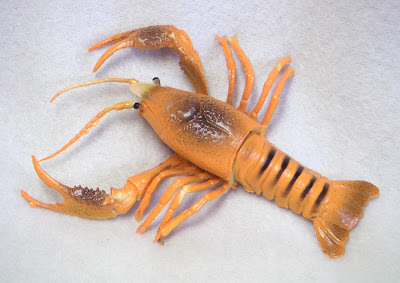
This realistic-looking flexible plastic crayfish replica or toy is made to look a lot like a real crayfish with bendable appendages. And, IT FLOATS! This replica has elaborate detail including tiny little feet and is painted orange with black stripes on the tail and gray detailing on the back, claws, and tail. Its eyes are a beady black that reflect highlights so it appears that the crayfish is actually looking at you! This could be good if you're using it for a diorama or toy, or it could be bad if you're using it for decor at a crayfish bake! Our crawfish has distinct detailing and is 4 1/2 inches long from tail to the tips of its feelers. Our plastic crawdad makes for a nice pet, fits into a shoebox diorama, or serves as a great collectible. This crustacean is for decoration or play only. Even though it floats, it should NOT be put in your aquarium with living fish. Check out our other lobster, shrimp and crayfish toys and gifts.

About Crayfish


Crayfish, crawfish or crawdads are freshwater crustaceans
and are related to lobsters. They are a commonly found in running freshwater streams and lake beds where they live in crevices or under rocks. They can not tolerate pollution but feed on dead organic matter and plants. There are numerous species of crayfish widely distributed throughout the world. In such diverse places such as China, Australia, France, Mexico, and Scandanavia, the tail is eaten as a delicacy in soups or bisques or the crawdad is served whole at feeds. No geographical place covets the crayfish more than in Louisiana where the crayfish can be found prepared in any number of Cajun recipes. Since the demand is so high they are farm raised making it an important food crop for the local economy. Not only do humans love crayfish, but they are an excellent bait for bass, muskies and crappie. Unfortunately fishermen have spread crayfish species that compete with native varieties. Crayfish also make lovely pets and can be kept in freshwater aquariums.

 This blog is sponsored by Tapir and Friends Animal Store.

Friday, January 18, 2013

Plastic Mud Crab


Another unique replica from Tapir & Friends!

Our Plastic Mud Crab


This engaging, realistic-looking plastic mud crab is both solid around the outside (yet slightly flexible) and hollow at the center with a squeeker inside. The legs are are about 7 1/2 inches wide and are both dark green and black. This crab floats. The body is about 3 inches long and 1 inch thick. This crab makes a nice pet, a gift or is useful for a diorama. Check out our other crab toys and gifts.

About Mud Crabs


The most common mud crab (Scylla serrata) is generally a mangrove crab but can also refer to several similar crabs found in mud throughout the world. Some mud crabs are large crabs with a smooth, broad carapace. They have 9 even sized teeth on each side of their eyes. Their two hind legs are flattened for swimming. In the most common form, the color varies from very dark brown/black to mottled green. Mud crabs inhabit sheltered estuaries, the tidal reaches of some rivers, mud flats and mangrove forests. These crabs are found scuttling along a soft, muddy bottom, often below low tide level. Some are harvested commercially especially in Australia but, for the most part, they make excellent bait for larger agressive fish.

This blog is sponsored by Tapir and Friends Animal Store.
Thursday, January 3, 2013

Realistic Plastic Lobster


Add this unique and detailed replica to your collection!

Our Plastic Lobster


This toy lobster is made of soft plastic. It's so realistic, it's almost a replica of a real lobster. Our lobster is slightly squeezable like a rubber animal, and it floats. When you fill it with water, it squirts from the mouth. When it's filled with air, it squeaks when you squeeze it! The 8 1/2-inch length is measured from the curved feelers to the end of its tail. Check out our other lobster and shrimp toys and gifts.

About Lobsters


Our lobster replica is a clawed lobster, a large marine crustacean related to freshwater crayfish. Clawed lobster fossils date back until at least the Cretaceous period, over 65 million years ago. Although their appearance is similar to scorpions, lobsters are not arachnids…they are arthropods, with ten legs total (the first three sets have claws, and the first of these are much bigger than the others). Lobsters are amongst the very few animals that show no detrimental effects of aging, continuing to grow and increase in fertility until an outside force (disease, predation, injury) causes death. Generally, lobsters are less than 20 inches long. The largest lobster was caught in Canada and weighed over 44 pounds.

Lobsters live in all oceans and may live as deep as 2000 fathoms, or 3700 meters. They are omnivores, preferring live fish, crustaceans and some plant life. In the wild lobsters have been known to scavenge, and have resorted to cannibalism in captivity where all other food sources are absent.

Lobster is an extremely popular and sought-after food. All commercial lobster are caught wild. While attempts to domesticate and farm lobster continue, none have been commercially successful. Lobster’s commercial popularity is relatively new, however. Prior to the mid-19th century in North America, lobster was considered a second-rate cuisine, fit only for the lowest members of society. Servants would specify that they “would not eat lobster more than twice a week” in their employment agreements. Well into the 20th century, lobster was used as fertilizer, fish bait, and a low-priced canned staple item, similar to tuna today.

This blog is sponsored by Tapir and Friends Animal Store.

Thursday, December 6, 2012

Plastic Rhomaleosaurus Marine Dinosaur


Feel like going swimming? Me neither.

Our Plastic Rhomaleosaurus Replica


Our plastic rhomaleosaurus marine dinosaur looks as scary as any sea monster you can imagine, but we promise, it won't bite! Look at the beautiful, realistic detail! Of course, this extinct Cretaceous predator was never seen by humans, so it is painted the way paleontologists think its coloring might have looked. Our plastic toy rhomaleosaurus is made of solid plastic and is quite durable. Be sure to take a look at our other dinosaurs as well as prehistoric animals and humans from many ages of Earth's history.

About Rhomaleosaurus


Cruising the English coastline more than 175 million years ago, the Rhomaleosaurus (Rhomaleosaurus cramptoni) was a large marine reptile of the Mesozoic era. This amazing predator was believed to be over 20 feet long and fed on ichthyosaurs, ammonites, and other plesiosaurs. The first fossils were unearthed in an Alum quarry near Whitby, England in 1848. Rhomaleosaurus was later given its scientific name by Harry Seeley (a British paleontologist) in 1874.

This blog is sponsored by Tapir and Friends Animal Store.

Wednesday, December 5, 2012

Plastic Blue Starfish


An excellent addition to any oceanic diorama!

Our Plastic Blue Starfish


This engaging, realistic-looking plastic starfish is both solid and has flexible rays. The body and underside has well-defined detail. It is 2 inches wide. It makes for a nice pet, gift, or is perfect for a school project or in a diorama. Check out our other starfish toys and gifts.

About Blue Starfish


The blue starfish (Linckia laevigata) is a common shallow water starfish. It is found mainly on reefs in the Pacific. It is gets its blue color from a blue pigment called linckiacyanin and some accessory yellow carotenoids.The blue starfish is a nocturnal scavenger and feeds primarily on algae. It produces saponin which is a chemical defense against predatory fish.

This blog is sponsored by Tapir and Friends Animal Store.

Sunday, October 21, 2012

Shrimp Keychains from Guatemala


The perfect gift for the fisherman, chef, or ocean-lover in your life!

Our Shrimp Beaded Keychains


The beading on these shrimp animal keychains is securely stitched into a woven fabric of beads and is very sturdy. Unlike some beaded animals I've seen that are beautiful and engaging but very delicate, these shrimp are durable and with normal handling will hold up extremely well. Check out our other shrimp items as well as our page of beaded keychains from Guatemala. When you purchase one of these unique keychain animals from our collection, you help in a number of ways. You help save tapirs, because that's what we do. You help the local artisans in Guatemala who need an outlet for their work (yes, jobs!), and you help my friend Catherine with her sustainable business of working with the artisans of Guatemala to maintain jobs for themselves and make beautiful art for many people around the world to enjoy.

About Shrimp


Many different, unrelated forms of crustacean fall under the heading of “shrimp.” Most shrimp require a marine environment to grow and reproduce…a very few species can tolerate freshwater environments. Shrimp can collect in schools or survive independently, and form the basic food source for many marine predators. Like lobster, shrimp walk very slowly, but swim (backwards) very quickly by snapping their tail. Unlike lobster, shrimp have been successfully farmed for human consumption since the 1970s, with almost a third of the world’s commercial shrimp supplied by farming.

While the word "prawn" tends to be used in North America to describe any big shrimp, there are biological differences between true shrimp and true prawns. Biologists can distinguish between the two by their gill structure, but an easy way to tell is to examine the segments that form the shrimp’s abdomen. On a shrimp, the second segment overlaps both the first and third segments. On a prawn, it overlaps only the first.

This blog is sponsored by Tapir and Friends Animal Store.

Friday, October 19, 2012

Plastic Lobster


Back by popular demand!!

Our Plastic Lobster


This toy lobster is made of soft plastic. It's so realistic, it's almost a replica of a real lobster. Our lobster is slightly squeezable like a rubber animal, and it floats. When you fill it with water, it squirts from the mouth. When it's filled with air, it squeaks when you squeeze it! The 8 1/2-inch length is measured from the curved feelers to the end of its tail. Check out our other lobster and shrimp toys and gifts.

About Lobsters


Our lobster replica is a clawed lobster, a large marine crustacean related to freshwater crayfish. Clawed lobster fossils date back until at least the Cretaceous period, over 65 million years ago. Although their appearance is similar to scorpions, lobsters are not arachnids…they are arthropods, with ten legs total (the first three sets have claws, and the first of these are much bigger than the others). Lobsters are amongst the very few animals that show no detrimental effects of aging, continuing to grow and increase in fertility until an outside force (disease, predation, injury) causes death. Generally, lobsters are less than 20 inches long. The largest lobster was caught in Canada and weighed over 44 pounds.

Lobsters live in all oceans and may live as deep as 2000 fathoms, or 3700 meters. They are omnivores, preferring live fish, crustaceans and some plant life. In the wild lobsters have been known to scavenge, and have resorted to cannibalism in captivity where all other food sources are absent.

Lobster is an extremely popular and sought-after food. All commercial lobster are caught wild. While attempts to domesticate and farm lobster continue, none have been commercially successful. Lobster’s commercial popularity is relatively new, however. Prior to the mid-19th century in North America, lobster was considered a second-rate cuisine, fit only for the lowest members of society. Servants would specify that they “would not eat lobster more than twice a week” in their employment agreements. Well into the 20th century, lobster was used as fertilizer, fish bait, and a low-priced canned staple item, similar to tuna today.

This blog is sponsored by Tapir and Friends Animal Store.

Thursday, October 18, 2012

Crab


Useful as both toy and decoration!

Our Plastic Crab


This engaging, realistic-looking plastic crab replica is colorfully painted. It is soft and hollow and squeaks. The artist who designed this crab chose the shape of a dungeness crab, but chose a paint color which is typical of a cooked crab rather than a living one, which is generally dark purple/brown in color. This does not bother us since we enjoy cooked crab often here on the Oregon Coast. I hope this crab makes you hungry. Check out our other educational crab toys and gifts.

About Dungeness Crabs


The dungeness crab (Cancer magister) is a species of crab found along the Northern Pacific Coast. It is numerous and harvested in crab pots placed at shallow depths. Many coastal communities depend on crabbing as a main source of income for the fishing community. The Dungeness crab has five pairs of appendages including two large claws, which it uses as defense and to tear open food. The Dungeness crab is an excellent scavenger and feasts on clams, small fish and other small crabs. It is usually about 8-10 inches wide and is named after Dungeness, Washington which is near Port Angeles, Washington.

This blog is sponsored by Tapir and Friends Animal Store.

Tuesday, September 18, 2012

Starfish Pins ~ Made in USA


Wear your support for animals on your collar!

Our Painted Starfish Pins


These gorgeous and unusual starfish pins are made in Washington and Idaho by a team of U.S. artists. The high-quality lapel pins or oversized tie tacks are unique. They are exquisitely detailed; the quality of the painting elevates each pin to an item of wearable art. Each one is cast in pewter and painted by hand. You will be delighted with the professional quality and artistic details of your piece of fish jewelry. The finish is extremely smooth and shiny, as you can see by the highlight from the scanner. It is also extremely durable. The pin is secured by two sturdy tacks on the back so it stays upright, and the finished product is not only beautiful, but satisfyingly substantial in weight. It can be used as a lapel pin, hat pin, tie tack, and more. This collectible animal pin is heirloom quality, and the details are so realistic, they are found in museum gift shops and bought by organizations in need of the perfect animal to represent their group.

About Starfish (Sea Stars)


There are currently about 1,800 varieties of starfish (also known as sea stars). All are echinoderms of the class Asteroidea, and live throughout the world's oceans, at all depths and all temperatures. While most starfish have five arms, creating a typical star-shape, many can have 10-50 arms. Even in species known to typically have five arms, individuals can develop "extras" due to abnormalities during their developmental or larvae stage. Some starfish can regenerate lost arms, and a very few, like the linckia star, can regenerage an entire starfish from a single living arm.

All starfish are predators, feeding primarily on clams, corals, snails, and any other animal they can catch. Once caught, the starfish forces open the shellfish and extends it's stomach into the prey's shell to devour it. While some species of starfish are themselves prey for pufferfish, triton snails, and other aquatic hunters, many starfish have adaptations to make themselves appear unappetizing or dangerous. By far, starfish are under the greatest threat humans, specifically humans' poluting of the oceans. Starfish draw seawater through their bodies, so any contaminant in the water can injure or kill starfish in great numbers.

This blog is sponsored by Tapir and Friends Animal Store.

Thursday, August 30, 2012

Lobster and Shrimp Pins


One of our many highly-detailed and stylish animal pins!

Our Painted Lobster and Shrimp Pins


These gorgeous and unusual lobster and shrimp pins are made in Washington and Idaho by a team of U.S. artists. The high-quality lapel pins or oversized tie tacks are unique. They are exquisitely detailed; the quality of the painting elevates each pin to an item of wearable art. Each one is cast in pewter and painted by hand. You will be delighted with the professional quality and artistic details of your piece of fish jewelry. The finish is extremely smooth and shiny, as you can see by the highlight from the scanner. It is also extremely durable. The pin is secured by two sturdy tacks on the back so it stays upright, and the finished product is not only gorgeous, but satisfyingly substantial in weight. It can be used as a lapel pin, hat pin, tie tack, and more. These collectible animal pins are heirloom quality, and the details are so realistic, they are found in museum gift shops and bought by organizations in need of the perfect animal to represent their group.

About Lobsters and Shrimp


For all their bug-like appearance, lobster and shrimp represent some of the most sought-after seafoods, both by humans and large marine animals.

Clawed lobster fossils date back until at least the Cretaceous period, over 65 million years ago. Although their appearance is similar to scorpions, lobsters are not arachnids…they are arthropods, with ten legs total (the first three sets have claws, and the first of these are much bigger than the others). Lobsters are amongst the very few animals that show no detrimental effects of aging, continuing to grow and increase in fertility until an outside force (disease, predation, injury) causes death. Generally, lobsters are less than 20 inches long. The largest lobster was caught in Canada and weighed over 44 pounds.

Lobsters live in all oceans and may live as deep as 2000 fathoms, or 3700 meters. They are omnivores, preferring live fish, crustaceans and some plant life. In the wild lobsters have been known to scavenge, and have resorted to cannibalism in captivity where all other food sources are absent.

Lobster is an extremely popular and sought-after food. All commercial lobster are caught wild. While attempts to domesticate and farm lobster continue, none have been commercially successful. Lobster's commercial popularity is relatively new, however. Prior to the mid-19th century in North America, lobster was considered a second-rate cuisine, fit only for the lowest members of society. Servants would specify that they "would not eat lobster more than twice a week" in their employment agreements. Well into the 20th century, lobster was used as fertilizer, fish bait, and a low-priced canned staple item, similar to tuna today.

Many different, unrelated forms of crustacean fall under the heading of “shrimp”. Most shrimp require a marine environment to grow and reproduce…a very few species can tolerate freshwater environments. Shrimp can collect in schools or survive independently, and form the basic food source for many marine predators. Like lobster, shrimp walk very slowly, but swim (backwards) very quickly by snapping their tail. Unlike lobster, shrimp have been successfully farmed for human consumption since the 1970s, with almost a third of the world’s commercial shrimp supplied by farming.

While the word "prawn" tends to be used in North America to describe any big shrimp, there are biological differences between true shrimp and true prawns. Biologists can distinguish between the two by their gill structure, but an easy way to tell is to examine the segments that form the shrimp’s abdomen. On a shrimp, the second segment overlaps both the first and third segments. On a prawn, it overlaps only the first.

This blog is sponsored by Tapir and Friends Animal Store.

Sunday, August 19, 2012

Sally Lightfoot Crab


They are REALLY this colorful!

Our Plastic Sally Lightfoot Crab


This engaging, realistic-looking plastic Sally Lightfoot crab replica is made of hard flexible plastic. It is 7 inches wide across the legs and the carapace (shell) is 2 3/4 inches wide. It does not float. Our Sally Lightfoot crab miniature has a kindly expression and promises not to pinch. This sally lightfoot crab replica makes a nice pet, a gift or fits into a diorama for a school project. See our other crab toys and gifts.

About Sally Lightfoot Crabs


The Sally Lightfoot crab (Percnon gibbesi) is one of the most common crabs along the coast of South America. It is especially prevalent along the rocky shores of the Galapagos Islands. The crab derives its name from the fact that it scuttles along on its tiptoes, thereby appearing light-footed. It has large eyes and remarkable vision. It runs very quickly, is incredibly hard to sneak up on and catch and, even as a group, changes directions almost instantly. It eats algae and almost any kind of organic refuse. The Sally lightfoot crab is a prolific breeder and fortunately is not endangered like many other animals in this region. If you think the colors in our plastic crab are exaggerated, take a look at this photo of a real Sally Lightfoot crab! They must be among nature's most colorful animals!

This blog is sponsored by Tapir and Friends Animal Store.

Friday, August 17, 2012

Belemnite Sea Creature


A sea monster from Earth's ancient past!

Our Plastic Belemnite Replica


Our belemnite measures 6 1/2 inches in length from the tip of its tentacle-like arms to the top of its head; the lateral fins measure 2 1/4 inches. This sturdy, hand painted plastic belemnite is made in Germany and comes with an attached tag describing this and three other fossil sea animals. This tag is printed in English and German. Our belemnite is captured with its tentacle-like arms stretched outward in "speed mode." Notice the fleshy tube underneath the head between the piercing eyes. This tube or funnel is used to propel itself suddenly. The realistic tentacle-like arms show the series of hooks for holding prey. Our plastic belemnite will withstand school projects and playtime and show well as an educational toy or collectors item. See our collection of plastic fossil animals the way they looked in real life.

About Belemnites


Belemnites (or belemnoids) are an extinct group of marine cephalopod, very similar in many ways to the modern squid and closely related to the modern cuttlefish. Belemnites were around from the late Carboniferous to the end of the Cretaceous, a period spanning over 200,000,000 (200 million) years. Belemnites were similar in shape to squid. The body consisted of a torpedo-shaped head and ten arms. The head contained the shell and all internal organs. Paired lateral fins on the head were used for swimming and steering. Eight of the arms were adorned with curved hooks for grasping onto soft-bodied prey. The other two arms were equipped with suckers. As with squid, belemnites possessed a beaklike mouth for eating, and an ink sac. The inklike contents could be ejected into the water, creating a dense cloud that confused an attacker and allowed the belemnite to escape. As with squid, belemnites probably traveled in schools, dove to considerable depths, and occasionally suffered mass mortality that produced large numbers of fossils in a relatively small area.

Belemnites were aggressive, free-swimming, marine predators. They could swim slowly, propelled by a rhythmic beating of the lateral fins, or produce sudden bursts of speed through a jet-propulsion system. An area within the lower part of the head would fill with water and forcefully empty through a flexible fleshy tube called the funnel. This rapidly propelled the organism in the direction opposite to which the funnel was pointed. Generally they swam with head forward and arms trailing behind. Because belemnite eyes were located close to their arms they could not easily see where they were going. As with squid, rapidly swimming belemnites sometimes suffered damaging collisions, as evidenced by numerous fossils of broken shells that appear to have healed.

This blog is sponsored by Tapir and Friends Animal Store.

Tuesday, July 31, 2012

Plastic Trilobite


This little guy is at the roots of EVERY family tree!

Our Plastic Trilobite Replica


Made of solid plastic, this trilobite's superior design and details make it a museum-quality replica or collector's item, and yet the price puts it in range for the average collector of plastic animals. Topside details include blue-gray eyes and the three ridged lobes for which it was named. The underside also shows the three segments and details of the trilobite's anatomy. It measures 2 inches wide by 3 inches long. The word "Trilobite" is embossed on the underside. Our model trilobite is made in Germany and hand painted; it comes with an informational tag in both German and English. This sturdy, durable trilobite is also excellent for school projects, novelties, party favors or even as a children's toy. Our plastic trilobite is for decoration or play only. It does not float, and should NOT be put in your aquarium with living fish or other aquarium dwellers. However, you can make a terrific ancient sea life shoebox diorama using this wonderful plastic trilobite replica.

About Trilobites


Trilobites were an early form of life on earth that have left many fossils, some of which has been made into beautiful jewelry. They appeared about 600 million years ago during the Cambrian period and ruled the earth for about 350 million years. Their descendants include centipedes, spiders, shrimps and insects. Trilobites lived in shallow seas, swimming, crawling, and burrowing. They evolved into many different forms during their reign. You can learn more about these interesting creatures at trilobite.com.

This blog is sponsored by Tapir and Friends Animal Store.

Friday, July 27, 2012

Coral


The perfect addition to any undersea diorama!

Our Plastic Coral


This engaging, realistic-looking plastic coral is made of solid, flexible plastic. The body has well-defined detail. It is 2 1/2 inches tall. It represents three different types of coral, staghorn, brain and rock coral. This adds color to a sealife school project or fits in a diorama. Check out our other sealife toys and gifts.

About Corals


Corals are marine organisms from the class Anthozoa and exist as small sea anemone-like polyps, typically in colonies of many identical individuals. The group includes the important reef builders that are found in tropical oceans, which secrete calcium carbonate to form a hard skeleton. Corals can eat by stinging and capturing small fish or obtain nutrients from algae. They make up shallow reefs especially off of Australia and Hawaii.

This blog is sponsored by Tapir and Friends Animal Store.

Saturday, July 21, 2012

Seahorse 3D Puzzle


Watch for our new line of fantastic 3D puzzles coming soon!

Our Seahorse 3D Puzzle


The details on this 3-D puzzle animal toy add another dimension, so you could say it is 4-D (3-D + details)! It is certainly one of the more detailed we have seen, making it an interesting replica as well as a fun toy for adults and children above the age of 3. This enchanting seahorse stands 4 1/2 inches tall and comes unassembled in a beautiful plastic nautilus shell. The pieces are cleverly fitted, flexible, and not too difficult to assemble. When completed, this splendid seahorse stands snugly on its blue plastic base for display on your shelf, TV, display cabinet, etc., along with your other favorite treasures. To see our entire inventory of puzzle animals, go to our 3-D Puzzle Animals page. Come look over our other seahorse and sea dragon toys and gifts.

About Seahorses


The yellow seahorse (Hippocampus kuda ) is one of the most common seahorses and is also known as the Common Seahorse, Spotted Seahorse, or Oceanic Seahorse. . It is found mainly in the Pacific and the Indian Ocean. It has a short crown, which is directed backwards. It is found in shallow water of not much more than 30 feet. They can be found in mangroves, coastal seagrass beds, estuaries, coastal bays and lagoons, harbors, sandy sediments in rocky littoral zones, and rivers with brackish waters. Seahorses pair for life. They are poor swimmers and generally remain anchored to rocks using their prehensile tails.

This blog is sponsored by Tapir and Friends Animal Store.

Wednesday, July 18, 2012

Striped Shore Crab


A remarkable replica of a facinating animal!

Our Plastic Striped Shore Crab


Our striped shore crab toy or replica is made of hard plastic and measures 2 1/4 inches from side to side and 2 inches from front to back. Its name is moulded into the underside. This plastic crab is one of our series of lively and lifelike plastic crustaceans. Its realistic shape and details will be enjoyed as part of a school project, diorama, plastic animal collection, as a party favor, or gift. Our striped shore crab toy is for decoration or play only. It does not float, and should NOT be put in your aquarium. However, you can make an interesting sea-life or aquarium shoebox diorama using this and other plastic sea life and aquatic mammals, sharks, fish, sea turtles, birds, and decor from our gift shop. There is no mess, no feeding, and no tank cleaning :) Come look through our entire collection of crab toys and gifts.

About Crabs


Although there are over 50 crab families and thousandss of species, all crabs have basically the same body plan: four pairs of walking legs and one pair of claws (also called nippers or pincers). Their shell is actually their skeleton, called an exoskeleton, and protects their thorax, gills and the internal organs of the head. Like the octopus and sea star, if a crab loses a limb it will regenerate (grow back).

This blog is sponsored by Tapir and Friends Animal Store.

Thursday, July 5, 2012

Hermit Crab


This replica is truely museum-quality! A fantastic figurine!

Our Hermit Crab Replica


This engaging, realistic-looking plastic hermit crab replica is 4 3/4 inches wide and 2 1/4 inches high. It is made of solid flexible plastic. Its legs are flexible, but not posable. The shell is made of the same hard plastic and is flexible at the front. Our hermit crab has a kindly expression and promises not to pinch. This hermit crab makes a nice pet, a gift or works well in a diorama. Check out our other crab toys and gifts.

About Hermit Crabs


There are approximately 500 different species of hermit crabs living in saltwater intertidal zones. It isn't a true crab, but has a soft belly which it protects by crawling into an abandoned mollusk shell. This behavior of living in an abandoned cave evokes the image of a hermit, thereby getting its name. As the hermit crab grows, it must find an ever larger shell to inhabit. The hermit crab is fussy about which shell it takes. It likes those that have anemones or sea plants growing on it and even decorates his shell with these living things. This provides a symbiotic relationship, food for them and they provide better security from predators through camouflage.There are land varieties of hermit crabs and, surprisingly enough, there is an organization of hermit crab pet lovers, who keep them at home in aquariums.

This blog is sponsored by Tapir and Friends Animal Store.

Saturday, June 30, 2012

Mud Crab


Looks a little like an 8-legged ninja, don't he?

Our Mud Crab


This engaging, realistic-looking plastic mud crab has a solid body, but flexible legs. It is 2 1/2 inches across with good detail. This crab makes a nice pet, a gift or is useful for a diorama. Check out our other crab toys and gifts.

About Mud Crabs


The most common mud crab (Scylla serrata) is generally a mangrove crab but can also refer to several similar crabs found in mud throughout the world. Some mud crabs are large crabs with a smooth, broad carapace. They have 9 even sized teeth on each side of their eyes. Their two hind legs are flattened for swimming. In the most common form, the color varies from very dark brown/black to mottled green. Mud crabs inhabit sheltered estuaries, the tidal reaches of some rivers, mud flats and mangrove forests. These crabs are found scuttling along a soft, muddy bottom, often below low tide level. Some are harvested commercially especially in Australia but, for the most part, they make excellent bait for larger aggressive fish.

This blog is sponsored by Tapir and Friends Animal Store.

Tuesday, June 26, 2012

Realistic, Flexible Plastic Crayfish


Yummy!!

Our Plastic Crayfish


This realistic-looking flexible plastic crayfish replica or toy is made to look a lot like a real crayfish with bendable appendages. And, IT FLOATS! This replica has elaborate detail including tiny little feet and is painted orange with black stripes on the tail and gray detailing on the back, claws, and tail. Its eyes are a beady black that reflect highlights so it appears that the crayfish is actually looking at you! This could be good if you're using it for a diorama or toy, or it could be bad if you're using it for decor at a crayfish bake! Our crawfish has distinct detailing and is 4 1/2 inches long from tail to the tips of its feelers. Our plastic crawdad makes for a nice pet, fits into a shoebox diorama, or serves as a great collectible. This crustacean is for decoration or play only. Even though it floats, it should NOT be put in your aquarium with living fish. Check out our other lobster, shrimp and crayfish toys and gifts.

About Crayfish


Crayfish, crawfish or crawdads are freshwater crustaceans and are related to lobsters. They are a commonly found in running freshwater streams and lake beds where they live in crevices or under rocks. They can not tolerate pollution but feed on dead organic matter and plants. There are numerous species of crayfish widely distributed throughout the world. In such diverse places such as China, Australia, France, Mexico, and Scandanavia, the tail is eaten as a delicacy in soups or bisques or the crawdad is served whole at feeds. No geographical place covets the crayfish more than in Louisiana where the crayfish can be found prepared in any number of Cajun recipes. Since the demand is so high they are farm raised making it an important food crop for the local economy. Not only do humans love crayfish, but they are an excellent bait for bass, muskies and crappie. Unfortunately fishermen have spread crayfish species that compete with native varieties. Crayfish also make lovely pets and can be kept in freshwater aquariums.

 This blog is sponsored by Tapir and Friends Animal Store.

You might also like

Related Posts with Thumbnails