Showing posts with label cuttlefish. Show all posts

Sunday, July 24, 2011

Squirting Cuttlefish


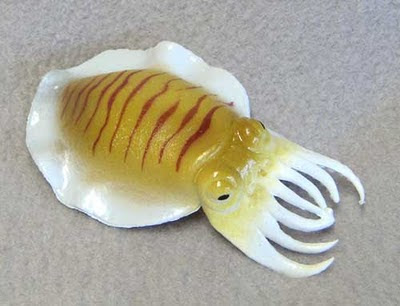
Our Cuttlefish squirts and is sure to bring hours of summer time fun!

This realistic-looking plastic cuttlefish squirts water from a tiny hole just below its eyes. It is light weight, squeezable, and looks a lot like the real thing. Although the tentacles are flexible, they are not posable. This plastic cephalopod is great for school projects, toys, novelties, animal collections, party favors and more. Our plastic cuttlefish is for decoration or play only. Although it floats, it should NOT be put in your aquarium with living fish. However, you can make an awesome sea-life or aquarium shoebox diorama using this and other plastic aquatic creatures and mammals, sharks, fish, sea turtles, birds, and decor from our gift shop.

About Cuttlefish

Cuttlefish, of which there are about 120 different species, are cephalopods. They are related to octopi, squid, and nautiluses. They are not fish, but are molluscs (or mollusks) and derive the name "cuttle" from an old German word meaning "pouch." Their bodies are composed of two long sucker-laden tentacles which are used to grab and secure prey - generally worms, small molluscs, crabs, shrimp and, unfortunately, other cuttlefish. Like other invertebrates and cephalopods, cuttlefish have a large internal shell (the cuttlebone) and two extraordinary w-shaped eyes, which, according to many scientists, are among the most developed in the animal kingdom. Although they can't see color, they distinguish contrast in great detail. Their eyes can work independently and one can look backwards as the other looks forward. As the eyes are fully developed at birth, it is thought that before hatching, cuttlefish eggs learn to recognize their future prey. Cuttlefish are found in warmer tropical waters, but not in the Americas. They use camouflage, rapid color change, and ink to communicate and to protect themselves from their many predators such as fish, sharks, dolphins, seals, and other cuttlefish.

This blog is sponsored by Tapir and Friends Animal Store.

Tuesday, September 14, 2010

New Plastic Cuttlefish Toy

Plastic Cuttlefish We're very excited to have a new cuttlefish in the store! We once had a cuttlefish that we liked very much, and so did our customers. Unfortunately, as often happens, just when everyone was showing their appreciation by buying them, the old cuttlefish was discontinued by its manufacturer. This often happens because our specialty online store (realistic animals) attracts customers like you who love animals and who appreciate this level of realism in a toy or replica. Not everyone does, and some of the best items are discontinued after only a short "life span." However, we keep on looking and finding the plush and plastic animals that please us and our customers, too!

Our Plastic Squirting Cuttlefish

This realistic-looking plastic cuttlefish squirts water from a tiny hole just below its eyes. It is light weight, squeezable, and looks a lot like the real thing. Although the tentacles are flexible, they are not posable. This plastic cephalopod is great for school projects, toys, novelties, animal collections, party favors and more. Our plastic cuttlefish is for decoration or play only. Although it floats, it should NOT be put in your aquarium with living fish. However, you can make an awesome sea-life or aquarium shoebox diorama using this and other plastic aquatic creatures and mammals, sharks, fish, sea turtles, birds, and decor from our gift shop.

About Cuttlefish

Cuttlefish, of which there are about 120 different species, are cephalopods. They are related to octopi, squid, and nautiluses. They are not fish, but are molluscs (or mollusks) and derive the name "cuttle" from an old German word meaning "pouch." Their bodies are composed of two long sucker-laden tentacles which are used to grab and secure prey - generally worms, small molluscs, crabs, shrimp and, unfortunately, other cuttlefish. Like other invertebrates and cephalopods, cuttlefish have a large internal shell (the cuttlebone) and two extraordinary w-shaped eyes, which, according to many scientists, are among the most developed in the animal kingdom. Although they can't see color, they distinguish contrast in great detail. Their eyes can work independently and one can look backwards as the other looks forward. As the eyes are fully developed at birth, it is thought that before hatching, cuttlefish eggs learn to recognize their future prey. Cuttlefish are found in warmer tropical waters, but not in the Americas. They use camouflage, rapid color change, and ink to communicate and to protect themselves from their many predators such as fish, sharks, dolphins, seals, and other cuttlefish.

Come see our new plastic squirting cuttlefish! In fact, take a few home for yourself or the kids. We ship anywhere!

This blog is sponsored by Tapir and Friends Animal Store.

Monday, August 30, 2010

Our Plastic Belemnite: Brand New Extinct Sea Animal


Our Plastic Belemnite

Our belemnite measures 6 1/2 inches in length from the tip of its tentacle-like arms to the top of its head; the lateral fins measure 2 1/4 inches. This sturdy, hand painted plastic belemnite is made in Germany and comes with an attached tag describing this and three other fossil sea animals. This tag is printed in English and German. Our belemnite is captured with its tentacle-like arms stretched outward in "speed mode." Notice the fleshy tube underneath the head between the piercing eyes. This tube or funnel is used to propel itself suddenly. The realistic tentacle-like arms show the series of hooks for holding prey. Our plastic belemnite will withstand school projects and playtime and show well as an educational toy or collectors item. See our collection of plastic fossil animals the way they looked in real life.

About Belemnites

Belemnites (or belemnoids) are an extinct group of marine cephalopod, very similar in many ways to the modern squid and closely related to the modern cuttlefish. Belemnites were around from the late Carboniferous to the end of the Cretaceous, a period spanning over 200,000,000 (200 million) years. Belemnites were similar in shape to squid. The body consisted of a torpedo-shaped head and ten arms. The head contained the shell and all internal organs. Paired lateral fins on the head were used for swimming and steering. Eight of the arms were adorned with curved hooks for grasping onto soft-bodied prey. The other two arms were equipped with suckers. As with squid, belemnites possessed a beaklike mouth for eating, and an ink sac. The inklike contents could be ejected into the water, creating a dense cloud that confused an attacker and allowed the belemnite to escape. As with squid, belemnites probably traveled in schools, dove to considerable depths, and occasionally suffered mass mortality that produced large numbers of fossils in a relatively small area. Belemnites were aggressive, free-swimming, marine predators. They could swim slowly, propelled by a rhythmic beating of the lateral fins, or produce sudden bursts of speed through a jet-propulsion system. An area within the lower part of the head would fill with water and forcefully empty through a flexible fleshy tube called the funnel. This rapidly propelled the organism in the direction opposite to which the funnel was pointed. Generally they swam with head forward and arms trailing behind. Because belemnite eyes were located close to their arms they could not easily see where they were going. As with squid, rapidly swimming belemnites sometimes suffered damaging collisions, as evidenced by numerous fossils of broken shells that appear to have healed.

Come see the new belemnite in our online store!

This blog is sponsored by Tapir and Friends Animal Store.
You might also like

Related Posts with Thumbnails