Friday, January 13, 2012

Stuffed Raccoon


Who was that masked mammal?

Our Plush Raccoon


Our stuffed raccoon is lifelike and oh, so cuddly-soft! The nose and eyes are made of plastic, and there are no claws to scratch a young child. Our stuffed raccoon is soft and adorable, and has a curious look in its wise-looking eyes. Its whiskers are made of soft, floppy strings that can't scratch or poke. The size is big enough to be snuggled by an adult or child. It would make a good companion on trips as well as at home. See our other raccoon toys and gifts.

About Raccoons


Raccoons are related to the cacomistle or bassarisk, a small ring-tailed mammal found from Oregon to Mexico. Other relatives are the coati mundi, kinkajou, and red panda. Raccoons belong to the Family Procyonidae. The giant panda was once classified as a member of the raccoon family, but is now considered to be a true bear. According to Wikipedia, "Raccoons are unusual, for their thumbs (though not opposable) enable them to open many closed containers (such as garbage cans and doors). They are omnivores with a reputation for being clever and mischievous; their intelligence and dexterity equip them to survive in a wide range of environments and are one of the few medium-to-large-sized animals that have enlarged its range since human encroachment began (another is the coyote).

This blog is sponsored by Tapir and Friends Animal Store.

Thursday, January 12, 2012

Fabric Monarch Butterfly Finger Puppet


An awesome toy, prop, or decoration!

Our Monarch Butterfly Finger Puppet


This engaging, educational and fun fabric monarch butterfly finger puppet is soft and cuddly and constructed with the quality of Folkmanis. The wings are made of orange and black soft plush transparent fabric and shows well-defined segments. The body is black and streches to allow a finger. Our monarch butterfly replica promises not to fly away. This fabric monarch butterfly finger puppet makes a nice pet, gift, novelty, presentation piece for a school project,or gag gift. See our other butterfly toys and gifts.

About Monarch Butterflies


The monarch butterfly (Danaus plexippus) is a well-known North American butterfly. It is a beautiful insect and has been drawn, photographed and appreciated by countless people. It is noted for its ability to make migration journeys of up to 3,000 miles where it loves to congregate on milkweed. It tolerates cold weather poorly so unsesaonable weather can have a devasting effect on the monarch butterfly. Monarch butterflies have few predators. They have an acrid taste which birds learn to avoid. Monarch butterflies can now be found in Hawaii and New Zealand.

This blog is sponsored by Tapir and Friends Animal Store.

Plastic Flying Mallard Duck


One of the beautiful replicas available at Tapir & Friends!

Our Plastic Flying Mallard


This flying mallard duck is one of our series of lively and lifelike plastic animals, or in this case, plastic birds. Its realistic shape and details will be enjoyed as part of a school project, diorama, plastic animal collection, as a party favor, or gift. The duck's feet are tucked up and trailing behind him as if in flight. Just so you know, he does not stand up.

About Mallard Ducks


The mallard, or wild duck (Anas platyrhynchos), is probably the best-known and most recognizable of all ducks. The male birds have a bright green head and the female birds have a light brown head. Mallard ducks live in wetlands and eat water plants. They are gregarious, migratory birds that form large flocks. Mallards ducks can reach 26 inches in length, have a wingspan of 39 inches, and weigh close to 3 pounds. Females can lay 8-13 eggs, which are incubated for 27-28 days before hatching. The duckling are born able to swin and feed themselves but stay near their mother for protection.

This blog is sponsored by Tapir and Friends Animal Store.

Wednesday, January 11, 2012

Carabiner Animal Flashlights


The sun's returning, but not very fast! Let these light your way!

Our Carabiner Animal Flashlights


Our carabiner animal flashlights are the coolest way to make sure you always have a light nearby! Look at the tail, they simply open up to snap onto a key ring, backpack, belt, book bag, or anyplace else a person can hook something. The light is surprisingly bright for such a small item! Keep one next to your bed, by the back door, inside your car or on your bike. The light is bright enough to find things in the dark - such as finding the lock on your house or car door. Helps keep both kids and adults safe when unexpected scenarios come up. Just press the button on the critter's back, and you have light! Is there a better way to find the outhouse on a camping trip than to let our flashlight animals find the trail for you? Or what about lighting your way on Halloween? Fun for birthday parties, as stocking stuffers, or Hanukkah gifts for any age. Check out our other bird toys and gifts and our multi-style animal flashlights. The animal flashlights page also shows you what the lights look like when the light is on! If you have a teeeeeny little screwdriver, you can pop in a replacement battery. However, we've noticed that the lights last for quite a long time on the original battery.

About Keel-Billed Toucans


Toucans are brightly-colored birds with distinctively-large bills, primarily located in Central and South America, Mexico, the Caribbean, and southern Florida. Toucans are omnivores, feeding primarily on fruits, eggs, insects, and small birds and reptiles. Both the male and female share responsibilities in caring for their clutch of 2-4 eggs, taking turns seated on the clutch to incubate their young. The large bill (usually 1/3 of the bird’s total length) is made of spongy, hollow bone struts covered in keratin, a hard protein that also makes up hair and nails in mammals.

Also known as the sulfur-billed and rainbow-billed toucan, the keel-billed toucan (Ramphastos sulfuratus) is typically 12-22 inches long and weighs under a pound. Keel-billed toucans are found from southern Mexico to Venezuela and Columbia.

This blog is sponsored by Tapir and Friends Animal Store.

Plastic Miniature Giraffe


A fantastic replica of an amazing creature!

Our Plastic Giraffe


This giraffe stands almost 7 inches tall. It's made of sturdy plastic and is very durable. Because it's larger, it has more detail than our smaller plastic animals. This giraffe is hollow and therefore light weight.

About Giraffes


Giraffes (Giraffa camelopardalis) are the biggest ruminant and the tallest mammal. They have very long necks with a short, upstanding mane. Their high shoulders slope steeply to their hindquarters. The head tapers to a point and they have a long, prehensile tongue. Their horns are solid bone and skin covered. Tails are hocklength, with a long tassel. Their brown to rich chestnut colored coat (old males are darker, even black) is dissected into intricate tapestry by patches and blotches of lighter hair. Each giraffe's markings are unique.

This blog is sponsored by Tapir and Friends Animal Store.

Tuesday, January 10, 2012

Plush Naked Mole Rat


There's nothin' wrong with NAKED!

Our Stuffed Naked Mole Rat


This imaginative-looking stuffed naked mole rat is made of extremely soft plush material. This replica has a detailed face and body with realistic-looking ridges and cute buck teeth. The naked mole rat is 9 inches long. This plush naked mole rat makes for a nice pet, fits into a stuffed animal collection or serves as a great cuddly friend. Check out our other rat toys and gifts.

About Naked Mole Rats


The naked mole rat (Heterocephalus glaber) is also known as the desert mole rat. It is found in East Africa, living underground in a harsh environment. It seems to lack sensations of pain and has a very low metabolism. It spends its time digging its way through tunnels using its large front teeth. Its lips are sealed behind behind the front teeth to keep dirt from getting into its throat. It sees poorly and has no hair to cover its pink-yellowish skin. It lives in colonies with tasks divided up similar to bee colonies.

This blog is sponsored by Tapir and Friends Animal Store.

Stuffed Walrus


Look who's back in stock at TPF!

Our Stuffed Walrus


Our stuffed walrus is especially soft, squishy, and cuddly. He has lots of wrinkles, just like a real walrus. It's one of the "Natural Poses" series by Wild Republic, a brand you know and trust as always maintining the highest standards of toy safety in today's world. All parts of this toy walrus are non-toxic and surface washable. He's not only cuddly, he's also colletible. Check out our other walrus toys and gifts. To find more animals in this line, or see a list of our entire inventory of stuffed animals, beanies and puppets, check out our Stuffed Animal Page.

About Walruses


The two subspecies of walrus, the Pacific, which is the largest, and the Atlantic live in the Northern Hemisphere in the arctic and subarctic regions. The tusks, which give the walrus its distinctive appearance, are found on both the male (bull) and female (cow). Cows weigh up to 2,800 pounds and reach up to 10 feet long. Bulls are much larger at up to 4,000 pounds and up to 12 feet long. Like sea lions, walruses are able to rotate their rear flippers under pelvis and pivot their front flippers to the side, giving them the abililty to walk and climb. These semi-aquatic mammals have a thick layer of fat beneath their tough leathery skin, which is covered by a thin layer of light brown hair. In warm weather, tiny blood vessels in the skin dilate, increasing circulation, which sheds excess body heat. This causes the skin to turn pink.

The hang tag on our stuffed walrus says, "Hello! I am a walrus. I'm a BIG guy - I'm more than 10 feet long and can weigh up to 2 tons. Aren't my tusks awesome? They are actually giant teeth. Although I live in the Arctic, I have a thick layer of fat called blubber that keeps me warm in the coldest weather. I can walk on all four of my fins and can even run as fast as you! Wanna race?"

This blog is sponsored by Tapir and Friends Animal Store.

Monday, January 9, 2012

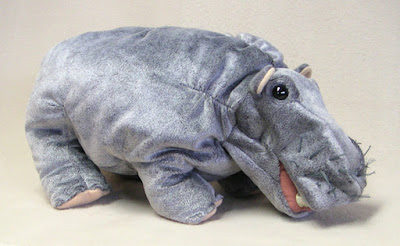
Plush Hippo Hand Puppet


This toy is as accurate and educational as it is adorable!

Our Plush Hippo Stage Puppet


Our very cute and lovable plush hippo stage puppet is 19 inches long and is crafted with fine workmanship from Folkmanis. It is 7 inches tall and has a 3 inch tail. It is with incredibly soft fabric and has realistic features. Your hand goes inside the hippo puppet's chest and works the mouth, so it can stand on your arm or on a puppet stage. It has shiny black eyes, soft plastic non scratchy tusks, and its whiskers are made of tufts of soft dark gray thread. Our hippo hand puppet makes for an enjoyable toy or pet or educational toy or fits nicely into a hippo collection. This stuffed hippo hand puppet may work well for school projects. Be sure to see our other hippo toys and gifts.

About Hippos


The hippopotamus (Hippopotamidae) spends most of its life in the rivers and lakes of Africa. Hippopotamus babies are born and nursed in the water. Adult hippos are dangerous and often engage in vicious fights with each other. As hippo expert Hans Klingel once noted, "Few animals are as recognizable as the hippopotamus." Indeed, it is almost impossible to mistake a hippopotamus for anything else. The body is long, barrel-shaped, and very deep. (I always thought they were more potato-shaped.) The limbs are short and pillar-like, with four toes on each foot. The hippo's neck is short and quite thick in order to support the weight of the massive head. The ears are small and round, the eyes are bulbous and protruding, and the muzzle is broad and rounded. The hippo's mouth is especially large; in fact, the hippo can open its mouth wider than any other living animal except the whales. The upper and lower canine teeth - often referred to as tusks - are long, thick, and very sharp. The animal has no hair except for a few stiff bristles on its muzzle, ears, and stubby tail. The skin color ranges from slate gray to copper brown on the back to pinkish purple on the belly and around the ears and eyes.

This blog is sponsored by Tapir and Friends Animal Store.

Plastic Amebelodon


You should see the size of his toothbrush!

Our Plastic Amebelodon


Made of solid plastic by Safari, Ltd., one of the best names in plastic toy animals, this amebelodon's superior design and details make it a museum-quality replica or collector's item, and yet the price puts it in range for the average collector of plastic animals. It measures 5 3/4 inches from the short trunk to the tail and stands 3 inches tall. It comes with an informational tag in French, Italian, Spanish, German, and English. This sturdy, durable prehistoric mammal is also excellent for school projects, novelties, party favors or even as a children's toy. You can make a splendid Ice Age shoebox diorama using this and other plastic creatures from our gift shop. Be sure to look over our other mammoth and mastodon toys and gifts.

About Amebelodon


Amebelodon first appeared in North America around 8-9 million years ago. After migrating across the Bering land bridge, this species of primitive proboscideans went extinct about 5 million years ago. Individual amebelodon varied a great deal in size, but the largest (Amebelodon britti) was 8-10 feet tall at the shoulder and weighed about 10 metric tons...larger than the biggest living elephant today.
The spade-like lower tusks of this species of mastodon earned them the nickname "Shovel Tuskers." These long, flat tusks were perfect for "shoveling up" plants, especially from the bottoms of ponds, and could also be used to scrape the bark off trees. The upper tusks were most likely used to defend against predators. Fossil remains of amebelodons have been found world wide, including in eastern Oregon in the 1930s.

This blog is sponsored by Tapir and Friends Animal Store.

Sunday, January 8, 2012

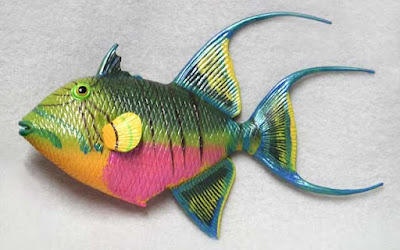
Plastic Queen Triggerfish


THIS queen can change its makeup at will!

Our Plastic Queen Triggerfish


This beautiful, realistic-looking queen triggerfish replica is made of solid plastic with flexible fins. The body together with the solid part of the fins is 4 7/8 inches long, but together with the flowing fins, this amazing museum-quality triggerfish miniature is 6 7/8 inches long. Our triggerfish toy has a myriad of colors and can be used as a gift, for a science project, for decorations, or as a collectible. Check out our other tropical fish toys and gifts.

About Queen Triggerfish


The Queen Triggerfish (Balistes vetulae) is a common reef fish found primarily in the Atlantic Ocean. It is a commonly found on coral rubble, tops of reefs and in sea grass. Large triggerfish can reach up to 18 inches, but most are small and can be suitable for aquariums, but not in conjunction with other fish. It is agressive and may feed on smaller species. Normally the triggerfish feeds on small crustaceans and shrimp. It is good at camoflauge since and can change color quickly when frightened.

This blog is sponsored by Tapir and Friends Animal Store.

Plastic Emu


Did you know one emu egg is the equivalent of a DOZEN chicken eggs?

Our Emu


This engaging, realistic-looking plastic emu is made of hard, but somewhat flexible plastic. The emu has detailed features with feather etchings. The weight of this figurine is a little out of balance, so you may wish to glue a base on its feet to insure it maintains a solid stance. It is painted gray with blue accents. It makes for an interesting ornament, table setting, toy, or serves well in a diorama or school project. Check out our other emu toys and gifts.

About Emus


The emu (Dromaius novaehollandiae) is the largest bird of Australia. It is second in size to the ostrich among all birds. It is a flightless bird and belongs to the group of ratites, including the kiwi, which is found in New Zealand and the cassowary, found in New Guinea. It has soft brown feathers and can run up to 30 mph. It weighs around 50 to 100 lbs, has small vestigial wings and only three toes. It feeds on seeds leaves and small insects and travels long distances to find the right food.

This blog is sponsored by Tapir and Friends Animal Store.

Saturday, January 7, 2012

Stuffed Plush Hermit Crab


Truely a unique addition to any plush collection!

Our Stuffed Hermit Crab


This playful stuffed hermit crab is made of extremely soft plush material. This replica has a detailed face and body with a loving expression. It is 12 inches long. It makes for a nice pet, fits into a stuffed animal collection or serves as a great cuddly friend and is fun for all kinds of games. Check out our other crab toys and gifts.

About Hermit Crabs


There are approximately 500 different species of hermit crabs living in saltwater intertidal zones. It isn't a true crab, but has a soft belly which it protects by crawling into an abandoned mollusk shell. This behavior of living in an abandoned cave evokes the image of a hermit, thereby getting its name. As the hermit crab grows, it must find an ever larger shell to inhabit. The hermit crab is fussy about which shell it takes. It likes those that have anemones or sea plants growing on it and even decorates his shell with these living things. This provides a symbiotic relationship, food for them and they provide better security from predators through camouflage.There are land varieties of hermit crabs and, surprisingly enough, there is an organization of hermit crab pet lovers, who keep them at home in aquariums.

This blog is sponsored by Tapir and Friends Animal Store.

Stuffed Krill


One of the smallest animals in the world, yet it feeds some of the biggest!

Our Plush Krill


This unusual-looking stuffed krill is soft, cuddly, and easy to hold. The legs are short, flexible, and are made of soft light pink, plush fabric. The body is bright pink and the head is covered with ribbed, silver-colored cloth with pink fur gills on each side. Two large black eyes, lots of antennae and a green thorax round out this lovely sea creature. Our krill has a kindly expression and wants to be your friend. This krill makes a nice pet or gift. Check out our other shrimp, lobster and krill toys and gifts.

About Krill


The krill are shrimp-like crustaceans that make up a vital part in the food chain. It is a small animal and varies in size from 1 to 4 inches. It is eaten by large mammals such as baleen whales and seals, by fish, and sea birds. Krill are the favored died of the blue whale, the largest aimals on earth. A blue whale can eat up to six million krill per day! Krill can be found in all the oceans and are near the surface at night and at greater depths by day. The name krill comes from Norwegian meaning small fry of fish.

There are many species of krill found throughout the world's oceans, but the most well-known krill is the Antarctic Krill or Euphausia superba. It can form large, dense swarms that attract whales, seals, penguins, squid, and predatory fish. By biomass, krill are perhaps the most successful multicellular animals in the world.

Krill are a type of plankton (actually zooplankton or "animal drifter"). Krill will eat even small zooplankton, but they prefer to dine on phytoplankton ("plant drifter") - and it is the abundance of this plant-life in their bellies that accounts for the green splotch visible through their transparent skin.

Although the international community outlawed the hunting of blue whales in 1966, many countries continue to harvest krill! Much of what is harvested becomes aquarium fish food, bait, or food for aquaculture fishes. But some is also used for human consumption. Krill have an intense, shrimp-like taste and are very salty. They are generally served minced or as a paste. However, because their exoskeletons contain a toxic fluoride, krill need to be processed immediately after harvesting. Otherwise, even little krill can kill.

This blog is sponsored by Tapir and Friends Animal Store.

Friday, January 6, 2012

Plastic Salmon


Amongst the First Nations, he's known as "suk-kegh"!

Our Plastic Salmon Model


This high-quality plastic salmon model is one of the most realistic plastic fish we have ever seen. It is suitable for museum and public aquarium displays as well as for school projects, science classes and biology education kits, educational toys, table decorations, restaurant decor and much more. The length is 5 inches, and the fins and tail are flexible but not posable. It will sit upright on a table with the head at a slighly downward angle.

About Sockeye Salmon


The sockeye salmon (Oncorhynchus nerka) is an oceangoing salmon that also lives in fresh water rivers. Therefore it is anadromus. It is found mainly in the North Pacific and its associated rivers, especially in British Columbia and Alaska, although in 2010 sockeye salmon have been returning in large numbers to the Columbia River which makes the border between Washington and Oregon. The name "Sockeye" is allegedly a folk adaptation of an Indian word from a tribe along the lower Fraser River. In the ocean, where the sockeye lives for 4-6 years, the fish is all silver in color with a blue tinge, but when it returns to the river to spawn, the male becomes bright red with a black face. Spawning season is usually in July or August and, of course, it is totally amazing that the sockeye salmon finds its way back to the source where it was born. It is theorized that each river has a characteristic odor that the sockeye has memorized and therefore navigates by smell.

This blog is sponsored by Tapir and Friends Animal Store.

Bushbaby Mother with Baby


Nothin' more snuggly than a momma and her baby!

Our Plush Bushbaby Mom and Baby


Our exceptionally soft, cuddly stuffed bushbabies by Fiesta are stitched together, giving you one mother and baby combination stuffed toy. Mom measures 9 1/2 inches to the top of her head in a seated position. Her wonderfully soft tail is 17 inches long, and that of the baby is 10 inches. What a cuddly pair! The eyes are hard plastic, and the cute pink noses are also made of plastic. The eyes, ears, legs and tail are securely attached making this charming stuffed animal duo a suitable toy for all ages. To find our other animals in the Fiesta line, or see our entire inventory of stuffed animals, beanies and puppets, check out our Stuffed Animal Page and Stuffed Beanies and Plush Puppets Page.

About Bushbabies


Like lemurs, bushbabies are prosimians, primates that are not as highly evolved as monkeys or great apes. Also called galagos and nagapies (Afrikaans for "night monkeys"), these small, nocturnal creatures are native to continental Africa. Their name comes from the animals' cries which sound much like a crying baby. Their strong hind legs, which are longer than their front legs, make them agile leapers. Their large eyes give them good night vision and their long tails help them balance. Their paws are remarkably like a human's hand with 4 fingers and a thumb.

This blog is sponsored by Tapir and Friends Animal Store.

Thursday, January 5, 2012

Plastic Fiddler Crab


This replica is actually close to life-size!

Our Plastic Fiddler Crab


Our fiddler crab is made of plastic and measures 2 1/4 inches from side to side and 2 inches from front to back. This plastic crustacean is one of our series of lively and lifelike plastic animals. Its realistic shape and details will be enjoyed as part of a school project, diorama, plastic animal collection, as a party favor, or gift. Our fiddler crab toy is for decoration or play only. It does not float, and should NOT be put in your aquarium. However, you can make an interesting sea-life or aquarium shoebox diorama using this and other plastic aquatic creatures and mammals, sharks, fish, sea turtles, birds, and decor from our gift shop. There is no mess, no feeding, and no tank cleaning :) Check out our terrific selection of crab toys and gifts.

About Fiddler Crabs


Although there are over 50 crab families and 1000s of species, all crabs have basically the same body plan: four pairs of walking legs and one pair of claws (also called nippers or pincers). Their shell is actually their skeleton, called an exoskeleton, and protects their thorax, gills and the internal organs of the head. Like the octopus and sea star, if a crab loses a limb it will regenerate (grow back).

The term "fiddler crab" describes any of approximately 100 species of crab of the genus Uca. Fiddler crabs are characterized by their mismatched claws. The little claw is used for feeding, the motion giving it the appearance of playing a fiddle (the large claw). If a fiddler loses the large claw, the small claw will grow to take its place and the lost claw will regenerate into a new small claw. Fiddler crabs are small, the largest being just over 2 inches across.

This blog is sponsored by Tapir and Friends Animal Store.

Plastic Farm Cat


An absolute necessity on ANY farm!

Our Plastic Toy Farm Cat


This engaging, realistic-looking plastic farm cat miniature is made of somewhat flexible plastic. This replica has detailed fur and is painted orange and white. This house cat makes for a nice pet, fits into a shoebox diorama, or serves as a great cat collectible. Check out our other cat toys and gifts.

About Cats


Cats, both pedigreed and domestic, come in a rainbow of colors and patterns. These are all a matter of genetics, so a calico mother might give birth in one litter to a calico, tabby, and solid or bi-colored kittens, depending on her genetic background and the background of the male cat that fathered the litter. Cats come in three basic colors: red (commonly called "orange," or sometimes affectionately referred to as "ginger," or "marmelade"), black, and white. Common patterns include tabbies, solids, tri-colored such as calicos, tortoise shells, tuxedos and bi-colored. House cats are also broken down into three categorie DSH - Domestic Shorthair, DLH - Domestic Longhair and DMH - Domestic Medium length hair. Studies have shown that cat owners show as much love or more for the common domestic cat as owners of pedigree cats show to their animals.

This blog is sponsored by Tapir and Friends Animal Store.

Wednesday, January 4, 2012

Plastic Dingo


An amazing addition to your Australian diorama!

Our Dingo


This engaging, realistic-looking plastic dingo miniature is made of somewhat flexible plastic with good quality. This replica has detailed fur and an attractive realistic pose and sharp eyes. This dingo replica makes for a nice pet, fits into a shoebox diorama, or serves as a great collectible. It is 1 3/4 inches long. Check out our other dingo toys and gifts.

About Dingos


The Dingo (Canis lupus dingo) is often called the Australian native dog. It is a domesticated dog which has been wild for a thousand years and lives independently from humans. There are similar dogs living in Thailand. Dingoes have a relatively broad head, a pointed muzzle, and erect ears. The fur of dingoes is short, bushy on the tail, and varies in thickness and length, depending on the climate. The fur color is mostly sandy to reddish brown, but can include tan patterns and be occasionally black, light brown, or white. Dingos are very often nocturnal in warmer regions, but more active during the day in cooler areas. Their main time of activity is around dusk and dawn. The periods of activity are short (often less than one hour) with short times of resting. They have two kinds of movement: a searching movement, apparently associated with hunting, and an exploratory movement, probably for contact and communication with other dogs.

This blog is sponsored by Tapir and Friends Animal Store.

Plastic Moose


Another delightful new toy from TPF!

Our Plastic Moose


This engaging, realistic-looking plastic moose is made of semi-flexible plastic. The antlers and legs can be bent easily, and they snap back to their original position. Our toy moose is 4 1/4 inches long. This moose is great for school wildlife projects, gifts, toys, party decorations, for your animal collection and more. Check out our other moose toys and gifts.

About Moose


Although moose vary in size and shape, they are the largest members of the deer family. Males weigh on average over 550kg (1200 lbs) and females often more than 400kg. Newborn calves weigh around 15kg but quickly increase in size. Their color varies from a little brown to a dusty black depending on the season and age of the animal. Young calves are often a light rusty color. The moose has a long nose, drooping lip, hump at the shoulders and small tail, so you can see that the details in our model moose are quite accurate. Our collectible moose even has cloven hooves. The flap of skin that hangs beneath the throat is called a BELL. The correct name for a female moose is a COW; the male is called a BULL, and the young moose is called a CALF. Mothers are extremely aggressive, probably due to the scarcity of food in the winter, their greatest threat to survival.

This blog is sponsored by Tapir and Friends Animal Store.

Tuesday, January 3, 2012

Plastic Blue Crab


Loved by millions...with a little lemon and garlic!

Our Plastic Blue Crab


Our plastic blue crab measures 2 inches from side to side. This plastic crustacean is one of our series of lively and lifelike plastic animals. Its realistic shape and details will be enjoyed as part of a school project, diorama, plastic animal collection, as a party favor, or gift. Our plastic crab toy is for decoration or play only. It does not float, and should NOT be put in your aquarium. However, you can make an interesting sea-life or aquarium shoebox diorama using this and other plastic aquatic creatures and mammals, sharks, fish, sea turtles, birds, and decor from our gift shop. There is no mess, no feeding, and no tank cleaning :) Be sure to look over our other crab toys and gifts.

About Blue Crabs


Although there are over 50 crab families and 1000s of species, all crabs have basically the same body plan: four pairs of walking legs and one pair of claws (also called nippers or pincers). Their shell is actually their skeleton, called an exoskeleton, and protects their thorax, gills and the internal organs of the head. Like the octopus and sea star, if the crab loses a limb it will regenerate (grow back).
Atlantic blue crabs (Callinectes sapidus) are found in the Gulf of Mexico, the Pacific coast of Central America, and the western waters of the Atlantic Ocean. While ignored as a food source in Central America, Atlantic blue crabs are fished extensively along the north Atlantic states of the United States. Atlantic blue crabs are the state crustacean of Maryland. In addtition to humans, Atlantic blue crabs are preyed upon by eels, sharks, trout, bass, and other fish. Atlantic blue crabs are omnivores, feeding on virtually anything smaller than themselves, including other blue crabs and carrion.

This blog is sponsored by Tapir and Friends Animal Store.

You might also like

Related Posts with Thumbnails